
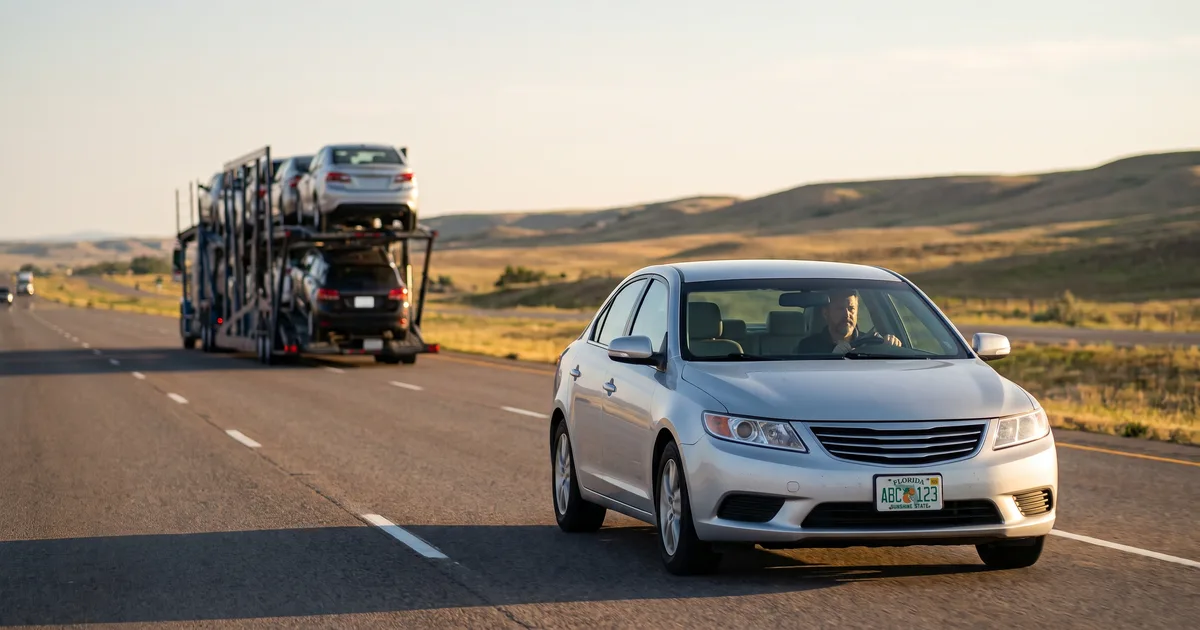

Driving is usually cheaper than shipping on short trips, and the math flips somewhere past the 1,000-mile mark. That flip happens because most people compare a shipping quote against a tank of gas, when the real cost of a long drive includes hotels, meals, time off work, and wear on the vehicle. For a sense of scale, the IRS raised its standard mileage rate to 76 cents per mile in July 2026, and that figure exists because fuel, maintenance, and depreciation together cost several times what the gas gauge shows. Once the comparison is honest on both sides, driving vs shipping a car becomes a distance and time question, not a price question.
SAKAEM Logistics is an FMCSA-licensed auto transport broker (MC 16237) that has arranged vehicle moves in all 50 states since 2017. Below is the same full-cost breakdown we walk customers through on the phone, including the scenarios where we tell people to just drive.
Key Takeaways
- Driving is clearly cheaper under 500 miles, while shipping usually wins the full-cost comparison past 1,500 miles.
- The cost of shipping vs. driving a car looks lopsided until you add lodging, food, wear, and days off work to the driving side.
- On routes under 1,000 miles, the truck often beats your flight, so plan for someone to release or receive the car.
- Shipping requires schedule flexibility at pickup, which is a real tradeoff that most companies leave out.
Cost to Ship a Car vs. Drive It
The honest comparison puts every cost on the table for both options.
Example: Driving vs. Shipping a 2,500-Mile Move
Here is what a typical coast-to-coast move looks like for one person in a mid-size sedan, using our current lane pricing and normal travel costs. Treat these as an illustration of the math, not a universal price list.
| Cost item | Driving yourself | Shipping the car |
|---|---|---|
| Fuel (25 mpg, ~$3.20/gal) | $290 - $340 | Included in quote |
| Lodging (4 nights) | $520 - $720 | $0 |
| Food on the road | $200 - $300 | $0 |
| Tolls | $50 - $100 | $0 |
| Wear and depreciation (~$0.20/mi) | ~$500 | $0 |
| Open transport (SAKAEM lane rates) | $0 | $1,150 - $1,550 |
| One-way flight | $0 | $150 - $400 |
| Total | $1,560 - $1,960 | $1,300 - $1,950 |
On money alone, a cross-country move is roughly a wash. The difference is four to five days of your life spent behind the wheel versus a few hours in an airport. For that corridor’s current range, see our California to New York car shipping lane.
Cost to Ship a Car
Car shipping is priced per mile, and the rate drops as distance grows. On open transport, short moves under 500 miles run $1.00 to $1.50 per mile, while cross-country moves fall to $0.40 to $0.55 per mile, which is how a 2,500-mile shipment lands in the $1,150 to $1,550 range. You can check the current number for your own route in our car shipping cost calculator. Enclosed transport adds 50 to 60 percent over open rates and makes sense for classic, exotic, and low-clearance vehicles. Route popularity matters too, since a lane with heavy carrier traffic prices tighter than a rural one. If budget is the priority, the cheapest way to ship a car is almost always open transport on a major lane with flexible dates.
Cost to Drive a Car in a Move
Fuel is the smallest driving expense, at roughly $130 per 1,000 miles for an average sedan. The bigger line items are the ones people forget: a hotel night for every 500 miles of safe daily driving, $40 to $60 a day in food, tolls on most eastern routes, and the mileage itself. Using a conservative 20-cents-per-mile allowance for depreciation and mechanical wear, a 2,000-mile drive quietly costs around $400 in vehicle value before anything breaks. Add unpaid days off work and the cost of shipping vs. driving a car narrows fast on any multi-day route.
Pros & Cons of Car Shipping
Shipping trades money for time and preservation. It is the option that keeps miles off the odometer, but it asks for flexibility in return.
Pros:
- Zero added miles, wear, or accident exposure for your vehicle
- Your time back, which matters most for moves that would take three or more days of driving
- Door-to-door service, with a carrier picking up and delivering as close to your addresses as trucks can legally get, with no terminal storage yards or daily fees on either end
- Carrier cargo insurance covers the vehicle during transport
- Multi-vehicle households move everything in one booking, and SAKAEM applies a multi-car discount
Cons:
- Costs more out of pocket than fuel alone on any route
- Pickup happens inside a window, not at an exact hour. SAKAEM’s standard window is 1 to 3 business days from your first available date, while much of the industry quotes up to 5
- Transit adds days on shorter routes where you could have driven it in one
- You are trusting your car to a stranger, which is why carrier vetting matters more than price
Pros & Cons of Driving a Car
Driving keeps you in full control of the schedule, and on the right trip it is genuinely the better call.
Pros:
- Cheapest option on short and medium routes, especially with two drivers splitting the trip
- You leave when you want and arrive when you planned, with no pickup window to manage
- The car is never out of your sight
- A road trip can be the point, not the cost
Cons:
- Every mile comes out of your car’s value and maintenance schedule
- Multi-day drives mean hotels, meals, and time off work that rarely make it into the mental math
- Fatigue is a real safety factor past 500 miles per day
- Weather, breakdowns, and route closures are your problem to solve mid-trip
What to Consider When Deciding Between Shipping or Driving a Car
Distance decides most cases, and a few personal factors decide the rest:
- Total mileage. The single best predictor of which option wins.
- Your daily rate. Days off work are a cost, whether or not they show up on a receipt.
- The vehicle itself. A leased car with mileage caps, a classic, or a low-clearance sports car all argue for the truck.
- Who is traveling. Kids, pets, and a packed moving schedule make a four-day drive a different proposition than a solo trip.
- How many cars are moving. Two cars means two drivers or two trips, and shipping usually wins outright.
| Distance | Our honest advice |
|---|---|
| Under 500 miles | Drive it. Shipping minimums make short hauls poor value |
| 500 - 1,000 miles | Driving is cheaper on paper; the gap closes once you count a hotel night and wear |
| 1,000 - 1,500 miles | Genuine toss-up. Decide on time and vehicle value, not price |
| Over 1,500 miles | Shipping usually matches or beats the full cost of driving |
When Car Shipping Makes Sense
Ship the car when the route is long, the schedule is tight, or the vehicle is worth protecting. Cross-country relocations, shipping a car across the country for a new job with a fixed start date, snowbird seasons, moving a second family car, and any classic or exotic vehicle are the textbook cases. Students and military families also ship heavily, and SAKAEM offers discounts for both.
When Driving Your Car Makes Sense
Drive when the trip is under 500 miles, when your dates are rigid and non-negotiable, or when the drive itself is something you want. A single-day route with no overnight stop is nearly impossible for shipping to beat on cost, and we say so on the phone every week. If your car is older with high miles already, depreciation barely moves and one of shipping’s biggest arguments disappears.
Ship and Fly: The Timing Detail Most People Miss
The standard plan sounds simple: the carrier picks up the car, you fly out the next morning, and you meet the truck at the destination. On long routes it usually works, because car shipping takes six to eight days coast to coast and your flight beats the truck comfortably.
On routes under 1,000 miles, the plan breaks more often than it works. Transit on those lanes is only one to three days, and pickup lands anywhere inside the assignment window, so the truck can arrive at the destination before you do, or the pickup can fall after your flight has already left. In our experience, when the customer is flying, somewhere between half and two-thirds of shorter-distance moves end up needing another person on one end of the shipment, depending on the route and carrier availability that week.
That is not a problem, it is a plan. Any adult you authorize can release or accept your car in your name with the keys and a heads-up to the driver. In practice our customers use a neighbor, a friend, or a relative. People relocating have asked their realtor to hand over the keys more times than you would guess, and customers staying at a hotel simply leave the keys with reception. Build that backup into your plan from the start and the tightest part of a ship-and-fly move stops being stressful.
How to Find a Car Shipping Company You Can Trust
Most car shipping, ours included, is arranged by brokers who match your shipment to a vetted carrier running your route. A good car shipping broker is the difference between a smooth move and a headache, so verify before you book:
- Check the license. Every legitimate broker and carrier has an FMCSA record you can look up free at safer.fmcsa.dot.gov. No MC number on the website is a walk-away sign.
- Read recent reviews, not the star average. Look at how the company handles problems, because in transport the problems are what you are paying someone to manage.
- Be suspicious of the lowest quote. Quotes hundreds below everyone else usually get renegotiated upward once your car is already scheduled.
- Know the honest drawbacks. Brokers do not drive the trucks, so pickup times depend on carrier schedules, and price quotes reflect a live market rather than a guaranteed rate. Any company that promises exact pickup hours or claims a price can never change is telling you what you want to hear.
SAKAEM verifies every carrier’s USDOT and MC authority, insurance certificate, and safety record before assignment, holds an A+ BBB accreditation, and carries a 4.6-star average across 544+ Google reviews.
Bottom Line
Driving vs shipping a car comes down to distance, time, and what the vehicle is worth to you. Drive the short trips and enjoy them. Ship the long ones, the tight-schedule ones, and the cars you care about preserving, because the full cost of a multi-day drive is far closer to a shipping quote than most people expect. SAKAEM Logistics has priced this decision for hundreds of thousands of customers since 2017, and we will tell you honestly when driving is the better deal. Get a free quote in about a minute and compare the real numbers for your route.
Driving vs. Shipping a Car FAQ
Is it cheaper to ship a car or drive it?
Driving is cheaper under about 1,000 miles, and shipping usually matches or beats the full cost of driving past 1,500 miles. The break-even point moves once you count lodging, food, wear, and time off work, not just fuel.
Is it better to ship a car or drive it when moving?
For moves under 500 miles, driving usually makes more sense. For cross-country moves over 1,500 miles, shipping often becomes the better option once you account for hotels, meals, vehicle wear, and several days of travel, while moves between 500 and 1,500 miles come down to your schedule and vehicle value.
What are the hidden costs of driving a car long distance?
Hotels, meals, tolls, and vehicle wear are the big four, plus days off work. The IRS values business driving at 76 cents per mile, and by that yardstick a 1,500-mile drive represents over $1,100 in vehicle and fuel cost before lodging.
Can I pack personal belongings inside my car when shipping it?
Yes, up to about 100 pounds at no extra charge, packed in the trunk and below the window line. More than that takes carrier approval and roughly $75 to $100 per additional 100 pounds, and the rules are covered in our guide to shipping a car with stuff in it.
Does auto transport insurance cover my vehicle during shipping?
Yes. The carrier’s cargo insurance covers your vehicle during transport, and SAKAEM verifies the certificate before assigning any carrier. Our auto transport insurance guide explains coverage limits and the claims process.
What types of vehicles can be shipped?
Nearly anything on wheels: sedans, SUVs, trucks, motorcycles, classic and exotic cars, golf carts, and non-running vehicles with a winch-equipped carrier. Oversized and inoperable vehicles cost more because fewer carriers can take them.
Do I have to be there in person for pickup and delivery?
No. Any adult you authorize can release or accept the vehicle with the keys, and on shorter ship-and-fly routes we recommend arranging that person in advance because the truck often moves faster than your travel plans.
How long does shipping take compared to driving?
Coast to coast, a carrier needs six to eight days in transit while driving takes four to five hard days. On routes under 1,000 miles, transit is one to three days, about the same as the drive.
How far in advance should I book car shipping?
One to two weeks ahead is ideal for most routes. SAKAEM’s standard pickup window is 1 to 3 business days from your first available date, so booking ahead mostly buys you better rates rather than faster pickup.
Is shipping a car safe?
Yes. Fewer than 1 percent of shipments involve any damage claim, and vehicles on a carrier avoid the accident risk, weather, and mechanical strain of a long drive. Verified carrier insurance covers the rare exceptions.