
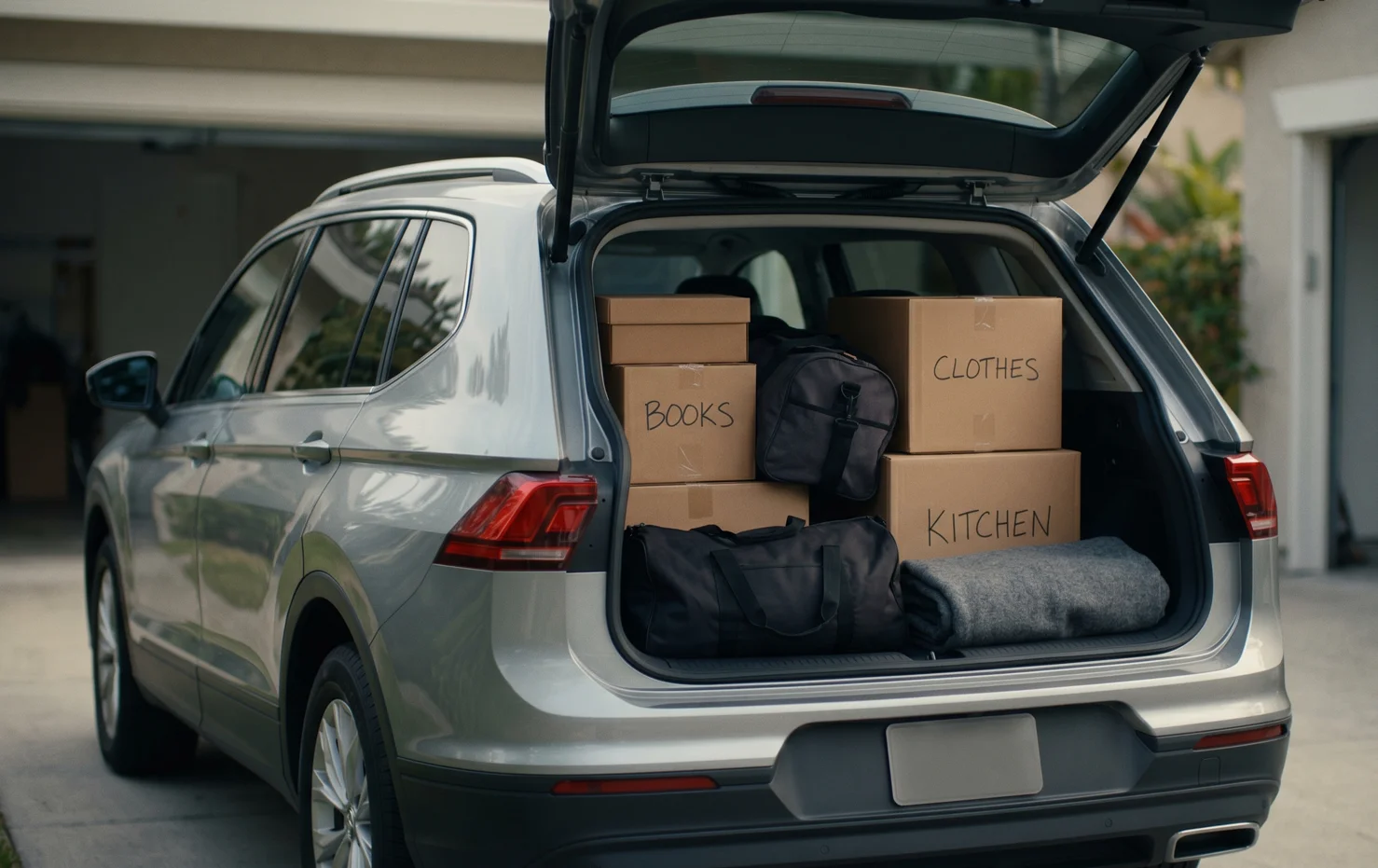

Shipping a car and belongings together is allowed by most auto transport companies, with limits. The industry-standard rule across reputable brokers and carriers in 2026 is up to ~100 lbs of items, in the trunk only, below the window line. Beyond that, carriers may agree to take more weight at the driver’s discretion, usually with a surcharge of $75–$100 per additional 100 lbs. None of it is covered by the carrier’s cargo insurance — only the vehicle is — so the items inside your car travel at your own risk. Federal Motor Carrier Safety Administration regulations on cargo securement and gross vehicle weight (49 CFR Part 393) and the 80,000 lb federal gross vehicle weight limit are the regulatory framework carriers operate inside.
The 30-second answer: Yes, you can put stuff in your car when shipping it — up to about 100 lbs in the trunk, below the window line, with no extra charge. Beyond that, expect a $75–$100 surcharge per additional 100 lbs, subject to carrier approval. Personal items aren’t covered by the carrier’s insurance — ship anything valuable separately. Hazardous materials, firearms, ammunition, perishables, and anything blocking visibility are absolute no’s. The basic rules apply whether you’re moving across town or shipping a car across country with belongings packed for a long-distance move.
Key Takeaways
- The industry-standard limit is ~100 lbs of items in the trunk only, below the window line — beyond that, expect a $75–$100 surcharge per additional 100 lbs and carrier approval.
- Carrier cargo insurance covers the vehicle, not the personal items inside — anything packed in the car travels at your own risk.
- FMCSA cargo securement rules and DOT 80,000 lb gross vehicle weight limits constrain how much weight a carrier can legally haul without risking station fines.
- Hazardous materials, firearms, perishables, and anything obstructing windshields, mirrors, or windows are non-negotiable prohibited items in every reputable carrier contract.
Is It Legal to Put Items in a Car When Shipping It?
Yes — strictly speaking, putting personal items in a car during transport isn’t illegal at the federal level. There is no FMCSA regulation that prohibits a small amount of luggage in a vehicle being transported on an auto carrier. What constrains the practice is a combination of carrier insurance limitations, federal weight regulations, and individual carrier policy. Most reputable auto transport brokers will quote a vehicle for transport with the assumption it’s reasonably empty; when items are added, the rules below kick in.
Insurance Limitations
Carrier cargo insurance is designed to cover the vehicle itself — its body, mechanical condition, and structural integrity in transit. Federal Motor Carrier Safety Administration–licensed carriers are required to maintain cargo insurance (typically $100,000–$250,000 per vehicle for open transport, higher for enclosed). That policy does not extend to personal belongings inside the vehicle. If a box of clothes, a laptop, or a piece of furniture is stolen or damaged during transport, the carrier’s policy will deny the claim. Your own homeowners or renters insurance may cover items in transit, but the carrier won’t. For more on what carrier insurance covers and what it explicitly excludes, see our guide to auto transport insurance.
FMCSA Guidelines
FMCSA’s cargo securement rules under 49 CFR Part 393 require carriers to secure all cargo, including the vehicles on the trailer, to prevent shifting in transit. Items piled inside a vehicle that could move during loading, unloading, or transit pose a securement risk the driver is responsible for. FMCSA also enforces the federal 80,000 lb gross vehicle weight limit for commercial vehicles. A car hauler running a full trailer is already near or at that ceiling — every extra 100 lbs of personal items pushes the truck closer to overweight territory, which means weigh station fines, hours-of-service compliance issues, and potential delays.
Other Common Guidelines
Beyond legal and insurance constraints, most carriers enforce common-sense operational rules:
- Trunk only for sedans — no items in the cabin or back seat. For SUVs, station wagons, hatchbacks, and pickup beds, the rear cargo area counts as the “trunk” — same rule applies, items stay in the back below the window line.
- Below the window line — driver needs to see through the rear and side windows during loading, securing, and inspection
- No items obstructing the windshield, mirrors, or VIN plate
- Vehicle must be drivable — no items stacked so high or heavy that the suspension is bottomed out
- All loose items secured — boxes taped, contents bagged, nothing that can roll or shift
A pre-pickup inspection by the carrier will flag any of these issues. If the load is unsafe or over the agreed weight, the carrier can refuse pickup until items are removed, or charge a surcharge to take the vehicle as-is.
Does It Cost More to Ship Items In Your Car?
Sometimes yes, sometimes no — it depends on weight. Here’s how SAKAEM Logistics handles it across the carriers we work with:
| Weight of items | Cost | Conditions |
|---|---|---|
| Up to ~100 lbs | No additional charge | Trunk only, below window line, secured |
| 100–500 lbs | $75–$100 per additional 100 lbs | Carrier discretion (not every carrier will accept) |
| 500+ lbs | Often refused or quoted separately as moving-load | DOT weight limits start mattering at this point |
A real-world example: a customer shipping a sedan from Florida to California (about 2,800 miles) might receive a base quote around $1,400–$1,800 for open transport. Adding 200 lbs of belongings (100 lbs over the free allowance) typically adds $75–$100. Adding 400 lbs adds $225–$300. By the time a customer is trying to load 500+ lbs of household items, they’re better served by a dedicated moving service or a separate freight shipment for the goods.
The economics work because every extra pound in the trailer costs the driver fuel and edges closer to DOT weight limits. Carriers who pass on a surcharge are pricing the actual operational impact — not nickel-and-diming.
Shipping Items In Your Car: Considerations
For people moving cross-country or relocating long-distance, using the car’s trunk for a small load of belongings can save money and a separate moving trip. Shipping a car across country with belongings packed in the trunk is one of the more common requests we see — a typical East Coast-to-West Coast move with 50–100 lbs of personal effects. For other situations — high-value vehicles, classic cars, or shipments with many heavy items — it’s often cleaner to ship the car empty (often via enclosed car shipping for high-value vehicles) and move belongings separately. To understand the broader pickup-to-delivery process, see our overview of how auto transport works.
Pros
- Saves a second shipment — one quote, one pickup, one delivery
- Less to coordinate — no separate moving company timing
- Lower total cost than hiring movers for a small amount of stuff (under ~200 lbs)
- Items arrive when the car does — no waiting for separate freight
- Useful for military moves — POV (privately owned vehicle) shipments often allow some personal items per service-branch rules
Cons
- No insurance on items — total loss risk on anything packed inside
- Theft risk at pickup/delivery points and during stops
- Damage to vehicle interior — items can shift and scratch upholstery, dashboards, or windows
- Higher quote risk — carriers who feel the vehicle is too heavy can refuse or charge extra at pickup
- Inspection delays — overloaded vehicles may need to be unloaded before transport
- Hazmat / regulatory liability — even unintentional violations (a forgotten can of paint, an aerosol) can trigger fines
Best Practices When Shipping Items in a Car
When packing a car for transport, prepare it the same way a professional driver would:
- Stick to the 100 lb limit unless you’ve cleared extra weight with your broker in advance and agreed on the surcharge in writing.
- Pack the trunk first, then the rear cargo area if the vehicle is an SUV — keep items below the window line at all times.
- Use secured containers — taped boxes, bagged contents, no loose items rolling around.
- Distribute weight evenly — heavy items low and centered, lighter items on top.
- Remove anything valuable — laptops, jewelry, cash, electronics, important documents go separately.
- Empty the gas tank to about a quarter full — less weight, easier loading on the trailer ramp.
- Document what’s in the car with photos and a written inventory at pickup. This won’t make items insured, but it does help resolve disputes.
- Confirm in writing with the broker what’s allowed before pickup so there are no surprises.
- Never pack hazardous materials — see the warning box below for absolute prohibitions.
CRITICAL: Absolute no’s for shipped vehicles. Under no circumstances pack any of the following inside the car: firearms, ammunition, fireworks, aerosols, propane or other compressed gas tanks, fuel canisters, household paint, loose lithium batteries, flammable liquids, or any item on the FMCSA hazardous materials list. A DOT roadside inspection that finds these can trigger federal fines (up to $10,000+ per violation) and an immediate offload of your vehicle at your expense.
Real-World Scenarios
How this plays out in practice:
Snowbird heading south for the winter
Florida-bound snowbirds often pack the trunk and floorboards with seasonal clothes, beach gear, and a few small kitchen items — usually 50–80 lbs. Well within the free allowance, no surcharge, items arrive when the car does at the Florida winter home. Common pattern for the snowbird car transport season.
Military PCS move
A service member transferring duty stations may ship their POV with a kit of personal effects — uniform gear, tools, small personal items. Some service-branch military car shipping reimbursements cover both the vehicle transport and a separate household goods shipment, but a military family often adds 100–150 lbs of personal items to the vehicle to avoid a second freight shipment. At 50 lbs over the free allowance, that’s a $75–$100 surcharge typically.
Hawaii, Alaska or overseas by ship
The free allowance above applies to the truck leg only. Once the car goes onto a vessel, the ocean carrier’s rules take over, and on RoRo shipping nothing at all may travel inside the vehicle; the lines refuse the car at the port gate if it is loaded. Empty it before the truck arrives, or ask the forwarder about a container, where personal items are sometimes allowed subject to customs.
Cross-country relocation with moving load
A family relocating from California to Tennessee may try to fit ~300 lbs of household items in the car’s trunk and cargo area to save on movers. At 200 lbs over the free allowance, that’s a $150–$200 surcharge — still cheaper than a separate freight pallet for items that small. Above ~500 lbs, the math flips: a dedicated freight or moving company beats trying to pack the car.
Bottom Line
Shipping a car and belongings together is allowed, common, and reasonable for moves up to about 100 lbs of items free, with a tiered surcharge after that. The real risks are insurance gaps (the carrier’s cargo policy doesn’t cover personal items), regulatory weight limits (DOT 80,000 lb gross vehicle limit affects what carriers can legally haul), and operational practicality (heavy or unsafe loads get refused at pickup). SAKAEM Logistics works with carriers across all 50 states who follow the standard tiered framework, rated 4.6 out of 5 across more than 540 customer reviews. When you request a quote, tell us upfront the approximate weight you plan to pack — that way the right carrier gets matched from the start, no surprises at pickup.
Shipping Items in Car FAQ
Can I put stuff in my car when I ship it with SAKAEM?
Yes. SAKAEM Logistics works with carriers who accept up to ~100 lbs of items at no additional cost, packed in the trunk (or rear cargo area for SUVs and hatchbacks) and kept below the window line. Beyond 100 lbs, additional weight is allowed at the carrier’s discretion with a surcharge of typically $75–$100 per additional 100 lbs. Let us know what you plan to pack when you request your quote so we can match you with a carrier that accepts the load.
Is the stuff inside my car insured during transport?
No. The carrier’s cargo insurance covers the vehicle itself, not personal items inside. Anything packed in the car travels at your own risk. Your personal homeowners or renters insurance may cover items in transit, but the carrier won’t. For high-value items, ship them separately via a service that explicitly insures contents.
What items are absolutely prohibited inside a car during shipping?
The FMCSA hazardous materials list applies: aerosols, propane, fuel canisters, ammunition, firearms, fireworks, flammable liquids, lithium batteries (loose), and any pressurized container. Beyond hazmat: no perishables, no live animals, no illegal substances, and nothing obstructing the windshield, mirrors, or windows.
Will adding items raise my shipping quote?
Up to ~100 lbs, no. Beyond that, expect a $75–$100 surcharge per additional 100 lbs. The exact amount depends on the route, carrier, and total weight. Tell your broker upfront what you’re packing so the quote is accurate from the start — surprises at pickup can lead to refused loads or last-minute fees.
Can I ship a car with the trunk full but the cabin empty?
Yes — that’s the standard arrangement. Trunk is the only acceptable storage location, with items below the window line. The cabin and back seat should be empty so the driver has clear visibility for loading, securing, and inspection.
What happens if the carrier refuses the load at pickup because of weight?
The carrier can refuse the load entirely or require you to remove items before they will haul the vehicle. To avoid this, confirm in writing with your broker what’s allowed and approximate weight before pickup. SAKAEM will flag in advance if a planned load is over what the assigned carrier accepts.
Are military service members allowed to pack belongings during a POV move?
Most carriers allow the standard ~100 lbs free, plus the per-pound surcharge for additional weight, on military POV shipments. Specific service-branch rules and reimbursement schedules vary — some military moves include a separate household goods shipment that should handle most personal items. The car shipment typically carries only uniform gear, tools, and small personal effects.
What if my items are damaged or stolen during transport?
The carrier has no liability for personal items inside the vehicle. If items are damaged or stolen, file a claim with your own homeowners or renters insurance — they may cover transit losses depending on your policy. Document everything at pickup with photos and a written inventory to support any claim.