
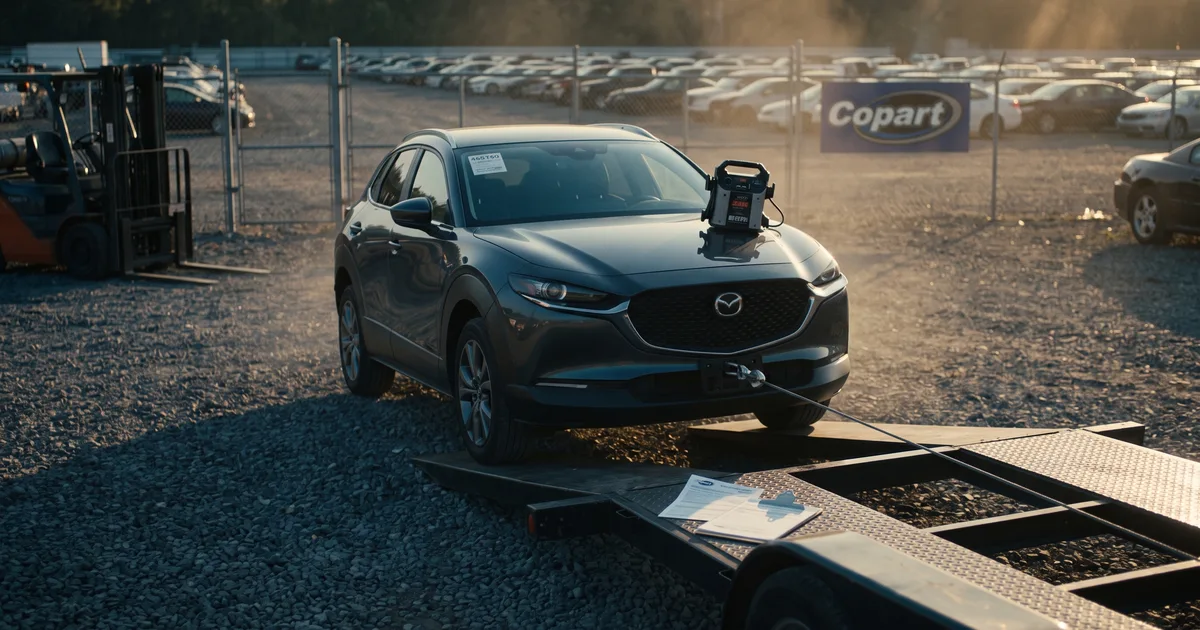

Myth: a car you won for $3,000 at Copart is a $3,000 car. Fact: by the time it is in your driveway, the same car has cost you the buyer fee, the gate fee, an environmental fee, possibly a late fee, possibly storage, and a transport bill that runs higher than a normal pickup because the vehicle is sitting in an auction yard. Copart fees are not hidden. They are published on Copart’s member fee schedule. They are just scattered, tiered, and priced differently depending on how you pay, and nobody at the auction is going to add them up for you.
This guide adds them up: every fee a public buyer pays as published in September 2026, the storage window that starts counting the day you win, two worked examples, and the transport cost that only shows up when you try to get the car home. SAKAEM Logistics is an auto transport broker holding FMCSA authority under MC 16237, and our dispatch team arranges about 50 auction pickups a month, so the transport sections come from the gate, not from a fee chart.
Key Takeaways
- The buyer fee is tiered by final bid, and paying by card costs 10 to 40 percent more per tier than paying by wire, per Copart’s September 2026 schedule.
- Every purchase adds a $95 gate fee and a $15 environmental fee. Pay within three business days or add $50. Leave it eight days and Copart relists the car for 10 percent of the bid, $600 minimum.
- Storage is set per yard and runs about $50 a day at the yards SAKAEM’s dispatch team uses most.
- About one in five vehicles listed as running is a non-runner at the gate, in SAKAEM’s experience. Plan the transport for that.
Copart Fees Line by Line
Copart charges a public buyer three fees on every purchase, the buyer fee, the gate fee, and the environmental fee, plus an internet bid fee on online wins and three fees that only apply if something goes wrong: late payment, relist, and third-party finance. All figures below are from Copart’s published U.S. non-licensed member fee schedule, checked in September 2026. Copart updates the schedule periodically, so confirm the current version before you bid.
Buyer Fee: Two Schedules, Not One
The buyer fee is a flat amount tied to the final bid, stepping up through more than 40 price bands, and Copart publishes two versions of it. Secured payment, meaning wire, cashier’s check, or money order, gets the lower schedule. Cards and other unsecured methods get the higher one. Above $15,000 it becomes a percentage: 7.5 percent on secured funds, 12.5 percent on unsecured. Online wins also carry an internet bid fee that scales with the sale price, up to roughly $140 to $160 above $8,000 per third-party copies of the schedule, so check your lot page. Membership is a separate annual cost.
| Final bid | Buyer fee, secured payment | Buyer fee, unsecured payment |
|---|---|---|
| $500 to $549.99 | $205 | $235 |
| $1,000 to $1,199.99 | $375 | $440 |
| $2,500 to $2,999.99 | $610 | $775 |
| $3,000 to $3,499.99 | $655 | $830 |
| $5,000 to $5,499.99 | $775 | $1,025 |
| $7,500 to $7,999.99 | $900 | $1,175 |
| $10,000 to $14,999.99 | $1,000 | $1,390 to $1,400 |
| $15,000 and up | 7.5% of bid | 12.5% of bid |
Source: Copart U.S. non-licensed member fees, September 2026. Representative bands shown; the full table has separate rows for every few hundred dollars.
See the full Copart buyer fee schedule, all 45 bands
| Final bid | Secured payment | Unsecured payment |
|---|---|---|
| $0 to $49.99 | $25 | $27.50 |
| $50 to $99.99 | $45 | $50 |
| $100 to $199.99 | $80 | $90 |
| $200 to $299.99 | $130 | $145 |
| $300 to $349.99 | $137.50 | $155 |
| $350 to $399.99 | $145 | $167.50 |
| $400 to $449.99 | $175 | $200 |
| $450 to $499.99 | $185 | $210 |
| $500 to $549.99 | $205 | $235 |
| $550 to $599.99 | $210 | $240 |
| $600 to $699.99 | $240 | $275 |
| $700 to $799.99 | $270 | $312.50 |
| $800 to $899.99 | $295 | $342.50 |
| $900 to $999.99 | $320 | $370 |
| $1,000 to $1,199.99 | $375 | $440 |
| $1,200 to $1,299.99 | $395 | $460 |
| $1,300 to $1,399.99 | $410 | $482.50 |
| $1,400 to $1,499.99 | $430 | $510 |
| $1,500 to $1,599.99 | $445 | $530 |
| $1,600 to $1,699.99 | $465 | $555 |
| $1,700 to $1,799.99 | $485 | $582.50 |
| $1,800 to $1,999.99 | $510 | $620 |
| $2,000 to $2,399.99 | $535 | $662.50 |
| $2,400 to $2,499.99 | $570 | $705 |
| $2,500 to $2,999.99 | $610 | $775 |
| $3,000 to $3,499.99 | $655 | $830 |
| $3,500 to $3,999.99 | $705 | $927.50 |
| $4,000 to $4,499.99 | $725 | $935 |
| $4,500 to $4,999.99 | $750 | $1,000 |
| $5,000 to $5,499.99 | $775 | $1,025 |
| $5,500 to $5,999.99 | $800 | $1,055 |
| $6,000 to $6,499.99 | $825 | $1,085 |
| $6,500 to $6,999.99 | $845 | $1,110 |
| $7,000 to $7,499.99 | $880 | $1,145 |
| $7,500 to $7,999.99 | $900 | $1,175 |
| $8,000 to $8,499.99 | $925 | $1,200 |
| $8,500 to $8,999.99 | $945 | $1,225 |
| $9,000 to $9,999.99 | $945 | $1,225 |
| $10,000 to $10,499.99 | $1,000 | $1,390 |
| $10,500 to $10,999.99 | $1,000 | $1,390 |
| $11,000 to $11,499.99 | $1,000 | $1,390 |
| $11,500 to $11,999.99 | $1,000 | $1,400 |
| $12,000 to $12,499.99 | $1,000 | $1,400 |
| $12,500 to $14,999.99 | $1,000 | $1,400 |
| $15,000 and up | 7.5% of bid | 12.5% of bid |
Source: Copart U.S. non-licensed member fee page, September 2026. Heavy vehicles use a separate schedule.
The gap between the two columns is the cheapest money you will save at Copart. On a $5,000 car it is $250. On a $20,000 car it is $1,000. If you can pay by wire, do.
Gate Fee
Copart assesses a $95 gate fee on every purchase, described as covering the move from the storage spot to the buyer loading area. It applies whether you collect the car yourself or send a carrier. Some third-party guides list a lower gate fee for clean titles; Copart’s own page shows $95, so budget that unless your invoice says otherwise.
Environmental Fee
A $15 environmental fee applies to every item sold. Small and unavoidable.
Late Payment Fee
Full payment is due within three business days of purchase, including the sale day. Miss it and Copart charges $50 per vehicle. The same three-day count drives the storage clock below.
Relist Fee
Leave a lot unpaid for eight calendar days including the sale day and Copart relists it, charging 10 percent of the final bid with a $600 minimum, taken from your deposit if you have one. A $2,000 car you walk away from costs you $600.
Third-Party Finance Fee
Paying through a Copart-affiliated finance company adds a $69 flooring service fee per transaction.
How Copart Compares With IAA
IAA tiers its buyer fee the same way, and at every price band its public schedule matches Copart’s secured-payment schedule to the dollar. The difference is in the add-ons: a $105 service fee per unit and a $20 title-handling fee as of October 1, 2026, per IAA’s non-licensed buyer fee page, against Copart’s $110 for gate plus environmental, plus a published internet bid fee of $40 to $160. IAA gives the award day plus four days of free storage at the branches we checked, charges $50 or 2 percent for late payment, and treats a car unpaid on day seven as a renege at $1,000 or 15 percent. Our IAAI fees guide walks through the full schedule and a side-by-side table, and our Copart vs IAAI comparison covers who can bid and how pickup differs.
The Storage Clock
Copart does not publish a single storage rate. Its fee page says rates vary by location, and each yard sets a short free period after the sale, commonly three business days including the sale day per third-party guides, then a daily charge until the car leaves. At the yards SAKAEM’s dispatch team picks up from most, that charge runs about $50 a day, per our operations team as of September 2026. Your lot page shows the exact rate and start date, and that number governs. The clock catches people because it counts from the same day as the payment deadline. A Thursday purchase at a yard with a three-business-day window:
| Day | What happens |
|---|---|
| Thursday | Sale day. Day one of the payment window and of the free storage window. |
| Friday | Day two. |
| Saturday and Sunday | Yard closed. Whether weekend days count against the free window depends on the yard. Assume they might. |
| Monday | Day three. Payment due today to avoid the $50 late fee. Last free storage day at most yards. |
| Tuesday | Storage begins, about $50 a day at the yards we work with most. |
| Following Thursday | Day eight. If the car is still unpaid, Copart relists it and charges 10 percent or $600. |
The practical rule that falls out of that table: the transport order has to be placed the day you win, not the day you pay. A carrier assigned on Friday can be at the gate Monday. A carrier requested on Monday is racing the clock from behind.
What a Copart Purchase Really Costs: Two Worked Examples
A $3,000 salvage sedan costs $4,215 to $4,415 to get home on a wire payment, and a $10,000 clean-title SUV $11,560 to $11,760, before the internet bid fee. Both examples assume a public buyer, an Atlanta-area yard, and a delivery about 400 miles away on an open carrier. Transport figures use SAKAEM’s published open-transport range for moves under 500 miles, $1.00 to $1.50 per mile, plus the auction pickup premium explained in the next section. Copart figures are from the September 2026 fee page.
| Line item | $3,000 salvage sedan | $10,000 clean-title SUV |
|---|---|---|
| Final bid | $3,000 | $10,000 |
| Buyer fee, secured payment | $655 | $1,000 |
| Gate fee | $95 | $95 |
| Environmental fee | $15 | $15 |
| Total at the yard, paid by wire | $3,765 | $11,110 |
| Same purchase paid by card | $3,940 | $11,500 |
| Open transport, 400 miles | $400 to $600 | $400 to $600 |
| Auction pickup premium | about $50 | about $50 |
| Subtotal before internet bid fee, wire payment, booked day one | $4,215 to $4,415 | $11,560 to $11,760 |
The transport line changes with distance more than anything else. Using SAKAEM’s published open-transport ranges by distance band and the $50 auction premium, an operable car leaving a Copart yard on an open carrier lands in these ranges:
| Distance from the yard | Open transport, published range | With the auction premium |
|---|---|---|
| Under 500 miles | $1.00 to $1.50 per mile | about $250 to $800 |
| 500 to 2,500 miles | current band in the cost guide | add about $50 |
| Over 2,500 miles | $0.40 to $0.55 per mile | about $1,050 to $1,600 |
Non-runners, enclosed transport, and expedited pickup all add to these figures. The mid-distance bands move with fuel and season, so the car shipping cost guide carries the current numbers rather than this table.
Won online? Add roughly $100 to $160 for the internet bid fee, per third-party copies of Copart’s schedule, since Copart does not list the tiers on its public fee page. Storage is excluded because the buyer in this example booked transport on the sale day and the car left inside the free window. Add it if yours does not.
Why Transport From Copart Costs More Than a Driveway Pickup
Buyers assume that a car bought below retail should ship below retail. It works the other way. When a carrier is choosing between vehicles in similar locations, an auction pickup typically quotes about $50 more than a driveway pickup, per SAKAEM dispatch data as of September 2026. The premium disappears only when there is nothing else in the area for the carrier to choose. It exists because an auction yard adds risk to the carrier’s day, and carriers price risk.
Jack, who runs operations at SAKAEM, explains it the way he explains it to customers:
“Carriers price a Copart pickup higher because they have to schedule an appointment. Most carriers give estimated pickup dates and times because they want flexibility on the route, and sometimes Copart has no availability on the date they need. If they drive out and the vehicle turns out to be inoperable, they may pick up a different vehicle instead, and that is a dry run. They lose money on it.” Jack, Head of Operations, SAKAEM Logistics
A dry run is the carrier’s term for a trip that ends with an empty spot on the trailer. On a driveway pickup, the driver calls ahead, the owner is there, and the car starts. At an auction yard, the driver needs a gate appointment, the buyer’s release, the lot and buyer numbers, and a vehicle that matches its listing. Any of those failing costs the carrier hours. In SAKAEM’s dispatch data, that friction translates to roughly a $50 premium.
What Booking Transport on Day Four Costs
Our dispatch team calls it the day-four caller, and sees it every week. Most auction buyers call for transport right after they win. A second group calls on day three or four, usually after another broker took the order and could not find a carrier willing to take an auction pickup at the price quoted. By then the free storage window is closing or closed, the buyer needs a truck immediately, and the buyer is understandably reluctant to pay more than the first quote.
“The buyer who calls on day three or four ends up paying more storage, which runs around $50 a day, and then pays more again for an expedited pickup.” Jack, Head of Operations, SAKAEM Logistics
The math on that call, using the $3,000 sedan above: an expedited pickup adds about $150 to $200 to the standard rate at SAKAEM as of September 2026, and two to three days of storage at $50 adds $100 to $150. The late caller pays $250 to $350 more than the buyer who booked on the sale day, for the same car on the same lane. The first broker’s low quote did not save money. It cost the buyer the free window.
This is the honest tradeoff. A quote that prices the auction premium in on day one looks more expensive than a quote that does not. The cheaper quote is cheaper only if a carrier actually accepts it in time. On auction pickups, they frequently do not.
What Happens If Your Copart Car Doesn’t Start at Pickup
“Runs and drives” holds until it doesn’t. Copart lists vehicles as running or non-running based on a yard check, and the listing is a starting point, not a guarantee. Across the roughly 50 auction pickups our dispatch team arranges each month, roughly one in five vehicles presented to us as running has been inoperable when the carrier arrived. Batteries die in the yard, fuel systems fail after weeks parked, and a car that started for the yard staff a month ago does not start for the driver today.
What happens next depends on the truck. Copart yards typically have a forklift and will load a non-runner onto the carrier at pickup. That solves half the problem. The other half is delivery.
“When the vehicle turns out to be inoperable at the yard, the driver calls us to check with the customer whether a forklift can be arranged at delivery. If it can’t, the driver may cancel.” Jack, Head of Operations, SAKAEM Logistics
A driver without a winch cannot unload a dead car at a residential address, and a driver with a winch still needs somewhere flat to set it down. The buyer has to arrange a forklift, a winch-equipped tow, or a shop with a lift at the delivery end. Nobody at the auction tells the buyer this, and it is the single most common reason an auction delivery falls apart after pickup.
The fix is upstream. Tell the transport company at booking that the car might not run, even if the listing says it does. A carrier assigned for a possible non-runner brings a winch and quotes accordingly. A carrier surprised at the gate makes a phone call, and sometimes that call ends the order.
What to Give the Transport Company Up Front
Dispatch moves as fast as the information it has. Send these with the order and a carrier can be assigned the same day:
- The yard name and address, plus your lot number and buyer number, which the gate requires for release.
- The date storage charges begin at your yard, so the order can be prioritized against it.
- Whether the vehicle runs, drives, rolls, and steers, and whether keys are present.
- The delivery address and whether a forklift, lift, or winch will be available there for a non-runner.
- Gate hours and any appointment requirements for your specific yard.
Copart and other auctions are a routine part of auction vehicle transport for a broker that handles them weekly, but only when the order arrives with those details. An order that says “Copart, pick up ASAP” starts a day behind. Enthusiast auctions run on a different clock entirely, since a Cars & Bids win is picked up from a private seller’s driveway rather than a yard with a storage meter.
What We Will Not Ship, and Why
SAKAEM will not take heavily damaged or totaled vehicles, or anything Copart classifies as a heavy vehicle, on a standard order. Heavily damaged or totaled vehicles are the first category. SAKAEM has tried to place these with carriers, and it is very difficult: a crushed roof, a bent frame, or a fire history cannot be secured safely on a standard open trailer, most carriers refuse outright, and the few who accept price it as a specialty move. Budget for a flatbed tow or a specialized hauler. The second is anything Copart classifies as a heavy vehicle, meaning medium and heavy-duty trucks, RVs, buses, and construction or farm equipment, which carry a different buyer fee schedule and need equipment ordinary car haulers do not carry. Everything else, including salvage-title cars, non-runners with intact bodies, and clean-title lease returns, ships every day.
How to Keep the Total Down
Most of the avoidable cost at Copart comes from timing and payment method, not from the fee schedule itself.
- Pay with secured funds. A wire transfer is the single largest saving available, 10 to 40 percent per tier.
- Book transport the day you win. Not the day you pay, and not day four. SAKAEM’s carrier assignment window is one to three business days, with about 95 percent of vehicles picked up inside it, so a same-day order usually clears the yard before storage starts.
- Assume the car might not run, and say so at booking. It costs nothing if the car starts and saves the order if it does not.
- Arrange the delivery end. Line up a forklift, lift, or winch tow at the destination before the truck leaves the yard.
- Use a broker that does auction pickups every week. Verify any auto transport broker in the FMCSA’s public database and ask how many Copart pickups they run. One that rarely does is more likely to underprice the pickup and delay carrier assignment, which is how the day-four problem starts.
If the yard is in another state, the interstate shipping guide covers title and registration timing. Remote buyers should read how online car buyer shipping works, including the VIN cross-check at pickup. And for Copart against the other car auction sites open to the public, that guide covers the field.
Bottom Line
Copart’s fees are published and set the moment the hammer falls. The costs that surprise buyers come after: the storage clock, the auction transport premium, and the non-runner that needs a forklift at both ends. Those are logistics, and they are the part the buyer controls. SAKAEM Logistics has arranged auction pickups as an auto transport broker since 2017, with a 4.6-star average across 580+ Google reviews. Get an auction transport quote with your lot and buyer numbers ready, book it the day you win, and the car leaves the yard inside the free window.
Copart Fees FAQ
How much are Copart fees?
For a public buyer, Copart fees are the tiered buyer fee, which runs from $25 on a sub-$50 item to $1,000 on a $10,000 to $14,999 car paid by wire, plus a $95 gate fee, a $15 environmental fee, and an internet bid fee if you won online. Above $15,000 the buyer fee is 7.5 percent of the bid on secured funds. Paying by card raises the buyer fee 10 to 40 percent per tier. Figures are from Copart’s September 2026 fee page.
How much are Copart fees on a $3,000 car?
With secured payment, a $3,000 winning bid carries a $655 buyer fee, plus the $95 gate fee and the $15 environmental fee, for an auction subtotal of $3,765. Pay by card and the buyer fee rises to $830, making it $3,940. Add the internet bid fee if you won online, then transport, and any storage if the car sits past the free window.
What fees does Copart charge after winning a bid?
After you win, Copart charges the buyer fee based on your final bid, the $95 gate fee, the $15 environmental fee, and any internet bid fee. If you pay late, a $50 late fee applies. If you do not pay within eight calendar days, the car is relisted and you owe 10 percent of the bid or $600, whichever is greater.
How long do you have to pick up a car from Copart?
Copart’s free storage window is set by each yard. Third-party guides describe the common structure as three business days including the sale day, after which daily storage applies. Your lot page shows the exact rule and rate for your yard. At the yards SAKAEM picks up from most, storage runs about $50 a day once the free period ends, billed to the buyer until the vehicle leaves.
What is the Copart gate fee?
The gate fee is $95 per purchase, as published on Copart’s non-licensed member fee page in September 2026. Copart describes it as covering administrative costs and moving the vehicle from storage to the buyer loading area. It applies whether you collect the car yourself or send a carrier.
What is the difference between secured and unsecured payment at Copart?
Secured payment means wire transfer, cashier’s check, or money order. Unsecured means credit or debit card and similar methods. Copart publishes a higher buyer fee schedule for unsecured payments, roughly 10 to 40 percent more per tier, and 12.5 percent instead of 7.5 percent on bids over $15,000.
What happens if I don’t pay Copart on time?
Payment is due within three business days including the sale day. Paying late costs $50 per vehicle. If the vehicle is still unpaid after eight calendar days including the sale day, Copart relists it and charges a relist fee of 10 percent of the final bid with a $600 minimum, taken from your deposit if you have one.
What if the car doesn’t start at the Copart yard?
The yard will usually forklift it onto the carrier. The problem moves to delivery, where you need a forklift, a lift, or a winch-equipped tow to unload it. On the auction orders SAKAEM runs, about one in five vehicles listed as running is a non-runner at pickup, so arrange the delivery end before the truck leaves.
How much does it cost to ship a car from Copart?
Transport from a Copart yard is priced like any other move, by distance, vehicle size, and open versus enclosed, plus an auction pickup premium of about $50 when carriers have other vehicles nearby to choose from, based on what our dispatchers see in September 2026. A 400-mile open move from an Atlanta-area yard runs roughly $450 to $650 all-in. Non-runners and expedited pickups cost more.