
The bill of lading is the single most important document in car shipping. It records what shape your vehicle was in when the carrier picked it up, what shape it was in when they dropped it off, and the terms you both agreed to. Sign it without reading and you can lose your right to file a damage claim. Sign it carefully and you have legal evidence of every dent, scratch, and missing part.
Key Takeaways
- A bill of lading is your contract, pickup receipt, and vehicle condition report rolled into one document, and the only paperwork your damage claim depends on.
- The BOL is signed twice: once at pickup with pre-existing condition noted, once at delivery with any new damage marked before the truck leaves.
- Never sign a BOL “subject to inspection” — that clause typically forfeits damage claims because it can be interpreted as acknowledging delivery in good condition before you have actually inspected.
- Digital BOLs through platforms like Super Dispatch and Central Dispatch are common, but paper BOLs are still legally valid and used by many smaller carriers.
What Is a Bill of Lading in Car Shipping?
A bill of lading in car shipping is a legally binding document that records vehicle condition at pickup, spells out the terms of transport, and acts as the receipt that the carrier accepted your vehicle for delivery. Federal law requires every motor carrier moving freight across state lines to issue one — the requirement sits in 49 CFR § 373.101.
The BOL is not a title document. The vehicle title — the DMV-issued ownership certificate — stays with you. The BOL is a contract and condition report only. For broader paperwork including titles, registration, and lienholder letters, see our car shipping documents guide.
What the Bill of Lading Does
The BOL serves four overlapping functions in a single document:
- Contract — the binding written agreement between the shipper and the carrier, locking in addresses, contacts, vehicle details, transport type, and terms.
- Pickup receipt — the carrier’s signed acknowledgement that they took possession of the vehicle on a specific date, from a specific person, at a specific location.
- Condition record — the inspection diagram where the driver marks pre-existing damage. Anything not marked at pickup is presumed undamaged at handoff.
- Damage claim foundation — the evidence that proves new damage at delivery. Without a BOL, there is no claim.
What Information Goes on a Car Shipping Bill of Lading?
Every car shipping BOL should include:
- Shipper name, address, and phone
- Pickup contact and delivery contact details (can be the customer or designated representatives)
- Carrier information: company name, USDOT and MC numbers, driver name and phone
- Vehicle details: year, make, model, color, VIN, license plate, mileage
- Vehicle condition diagram with standardized damage codes
- Operability status (drivable / non-operable)
- Pickup and delivery addresses and dates
- Transport type (open or enclosed)
- Special instructions: low-clearance, lifted, oversized, top-load preference, or personal items inside the vehicle that should be disclosed
- Price agreed to the carrier
- Signatures with date and time at both pickup and delivery
Missing fields are how legitimate claims get denied later. Confirm everything is filled in before the truck leaves the pickup or delivery point.
The Vehicle Condition Report: the Most Important Part of the BOL
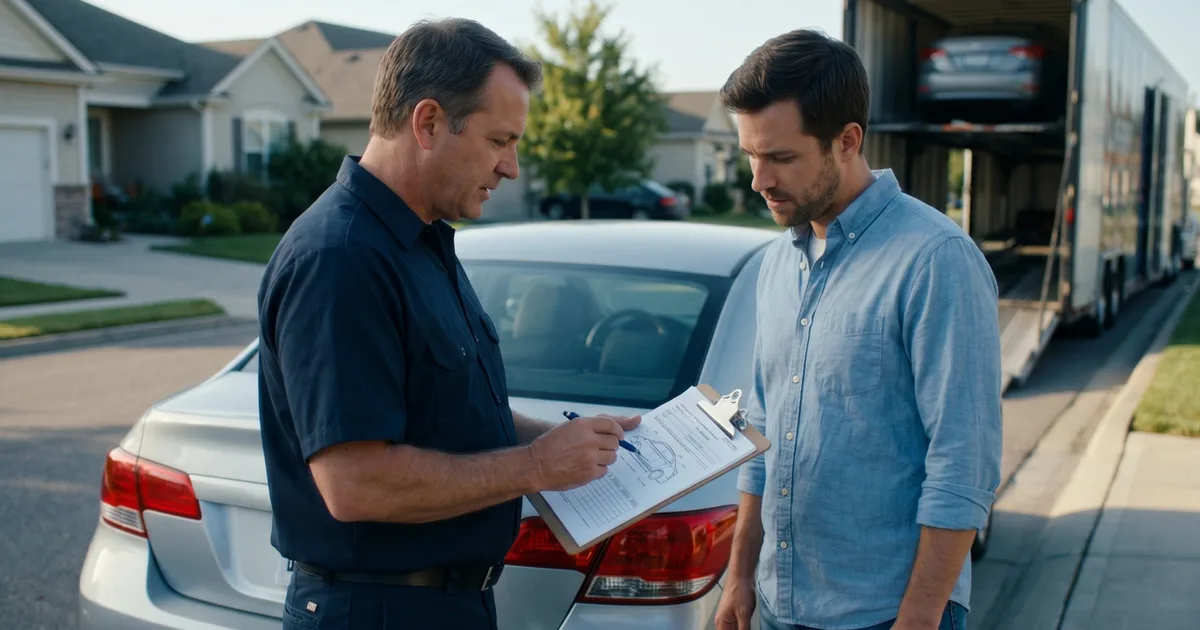
The vehicle condition report (VCR) is the section that determines whether you can collect on a damage claim. At pickup, the driver walks around the vehicle and marks every pre-existing imperfection on a diagram using standardized codes (S = scratch, D = dent, C = chip, B = broken, R = rust).
Before the truck leaves pickup:
- Walk the vehicle with the driver and confirm every mark matches reality.
- Photograph all four sides, the roof, the wheels, and any pre-existing damage close-up.
- Take a short walk-around video — timestamps matter.
- Read the BOL, including the back of the page where terms are often printed.
- Sign only once the diagram, mileage, and damage codes accurately reflect what you can see.
At delivery, the driver and the delivery contact repeat the process. New damage gets added to the delivery diagram before signing. Skipping or rushing this step is the single most common reason damage claims get denied.
Pickup vs Delivery: How the BOL Gets Signed Twice
The bill of lading is the same document signed twice — once at each end of the transport. Each signature carries different legal weight.
| Pickup BOL | Delivery BOL | |
|---|---|---|
| What it establishes | Pre-existing vehicle condition before transport | Final vehicle condition after transport |
| Who signs | Pickup contact + driver | Delivery contact + driver |
| Why it matters | Becomes the baseline for any future comparison | Crystallizes claim rights — once signed clean, claims become much harder |
| What to do before signing | Verify pre-existing damage is fully marked | Inspect for new damage and mark anything found before signing |
The pickup and delivery contacts do not have to be the customer — a relative, friend, dealer, or designated representative can sign on either end, as long as the booking broker has that contact in advance. If the delivery contact is someone other than the customer, brief them: tell them what to look for, ask them to photograph the vehicle before signing, and call you the moment they see anything off. For the full customer-side workflow at each stage, see our step-by-step car shipping guide.
Digital vs Paper Bills of Lading
The BOL format depends on the carrier. Larger fleets on dispatch platforms produce digital BOLs through apps like Super Dispatch or Central Dispatch. Smaller owner-operators still use paper BOLs — usually three-part carbon-copy forms.
| Format | Examples | Pros | Cons |
|---|---|---|---|
| Digital BOL | Super Dispatch, Central Dispatch, SmartHaul | Photos attached, automatic timestamps, cloud-stored, emailed to customer | Requires carrier to be on the platform |
| Paper BOL | Three-part carbon forms (white/yellow/pink) | Universal, no app or signal needed | Easy to lose, no photo attachments |
Both formats are legally valid. The Electronic Signatures in Global and National Commerce Act (E-SIGN Act) and FMCSA both recognize electronic BOLs and electronic signatures as equivalent to paper. Format does not affect your claim rights — what matters is that the document accurately reflects condition at both ends and the customer receives a copy.
Common BOL Mistakes That Can Weaken Damage Claims
Most denied claims were not denied because of the damage itself — they were denied because of paperwork mistakes at handoff. The most common:
| Mistake | Why It Hurts the Claim |
|---|---|
| Signing the BOL without inspecting | Removes proof the damage wasn’t pre-existing |
| Signing “subject to inspection” at delivery | Often interpreted as acknowledgment of good condition before inspection — many insurers reject claims signed this way |
| Inspecting in poor light (night, rain, dirty vehicle) | Damage missed at delivery is typically treated as “not present at handoff” |
| Pre-existing damage not marked on pickup BOL | New damage can be challenged as pre-existing |
| Not receiving a copy of the pickup BOL | No baseline to compare against at delivery |
| Damage noted after signing the delivery BOL clean | Claim rights generally weaken significantly after the delivery signature |
| Missing carrier USDOT/MC, customer info, or VIN | An incomplete BOL can be challenged as unenforceable |
| No photos at pickup or delivery | Without them it is word against word |
The “subject to inspection” trap is the most common scam vector. If a driver delivers at night, in a rainstorm, or pressures the customer to “just sign and we’ll figure it out later,” refuse. If conditions don’t allow a real inspection, ask the driver to move the vehicle to a well-lit gas station canopy, parking lot, or your garage — and don’t accept “I don’t have time.” A few extra minutes of inspection is the entire reason the BOL exists. If the move still isn’t possible, note the constraints (night, rain, etc.) directly on the BOL itself before signing. For more on the patterns to watch for, see our auto transport scams guide.
What to Do If Damage Isn’t Noted on the BOL at Delivery
If new damage shows up at delivery, before signing:
- Stop. Do not sign until everything new is recorded.
- Photograph and video everything — wide shots, close-ups, all sides.
- Add the new damage to the delivery BOL using standardized codes. Be specific about location.
- Have the driver initial each added mark before the BOL is signed.
- Call SAKAEM (or your booking broker) immediately — do not wait until the carrier has left.
If damage is discovered after the driver has already left and the BOL was signed clean, claim rights become significantly harder to enforce. Concealed damage that could not reasonably be seen at delivery (underbody scrapes, interior damage hidden by belongings, mechanical issues that only show up later) can sometimes still be claimed, but the process is slower and the burden of proof higher.
How SAKAEM Handles BOL Disputes and Damage Claims
When BOL-documented damage shows up at delivery, SAKAEM acts as the intermediary between the customer and the carrier:
- The customer or delivery contact calls SAKAEM the moment damage is noticed.
- The customer emails the full documentation — pickup BOL, delivery BOL with the damage marked, photos, and video.
- SAKAEM contacts the carrier directly to push for an out-of-pocket settlement. Carriers in our active network value their standing — most resolve minor cosmetic damage quickly to avoid an insurance claim affecting their rates and FMCSA safety scores.
- If the carrier declines an out-of-pocket settlement, SAKAEM provides the customer detailed instructions on filing a cargo claim with the carrier’s insurance company.
A broker like SAKAEM does not pay cargo damages directly — under FMCSA structure, cargo liability sits with the carrier and their cargo insurance (typically $100,000–$250,000 per vehicle, with policy aggregates of $500,000–$1 million per load). What the broker brings is leverage. The customer is not chasing the carrier alone; SAKAEM has the dispatch records, the relationship, and the network standing to push for a faster resolution. Combined with clean pickup and delivery BOLs, most claims resolve in two to six weeks through insurance; out-of-pocket settlements often resolve within days. For more on what insurance actually covers, see our auto transport insurance guide.
Bottom Line
A bill of lading is not just paperwork to sign. It is the single document that controls whether you can collect for damage during transport. The hour spent inspecting carefully, photographing thoroughly, and marking the BOL completely is the cheapest insurance any customer can buy.
SAKAEM vets carriers across the network specifically for documentation discipline — driver-side BOL completeness, clean inspection diagrams, and prompt photo documentation. Combined with broker-led dispute mediation, BOL issues get resolved faster than they would customer-to-carrier alone. Get a quote and book transport that takes the paperwork as seriously as the driving.
Bill of Lading FAQ
How does the bill of lading protect my vehicle during transport?
The BOL creates the legal record of vehicle condition at pickup. If anything changes between pickup and delivery, it is the proof that the damage happened in transit and is the carrier’s responsibility. Without it, there is no documented baseline.
Does the bill of lading include the vehicle condition report?
Yes. The condition report — a diagram showing pre-existing damage with standardized codes — is the most important part of the BOL and the section every damage claim depends on.
Who signs the bill of lading at pickup and delivery?
The driver always signs both. On the customer side, the pickup contact signs at origin and the delivery contact signs at destination. These can be the customer or anyone the customer designates — a family member, friend, dealer, or other representative — as long as the booking broker has the contact information in advance.
Can I refuse to sign a bill of lading?
Yes, if it is inaccurate or incomplete. Do not sign if the condition diagram is missing damage you can see, if vehicle or carrier details are wrong, or if delivery conditions make a real inspection impossible. Note the issue on the BOL itself before signing or call the booking broker.
What is a “subject to inspection” clause and should I sign one?
“Subject to inspection” is wording some drivers add when a real inspection isn’t possible — usually night, rain, or a rushed handoff. Signing it can be interpreted as acknowledging the vehicle was delivered in good condition before the customer has actually inspected. Most carriers and insurers will deny damage claims signed this way. Do not sign it. Note the constraints on the BOL itself and inspect before signing.
Is the bill of lading the same as my vehicle title?
No. The vehicle title is the DMV-issued ownership document and stays with you. The BOL is a contract and condition report only — it does not transfer ownership and does not replace the title.
How long should I keep the bill of lading after delivery?
At minimum, keep pickup and delivery BOLs for 90 days after delivery — this covers the typical claim window most carrier cargo policies allow. Many shippers keep both copies indefinitely, especially if the vehicle is later sold.