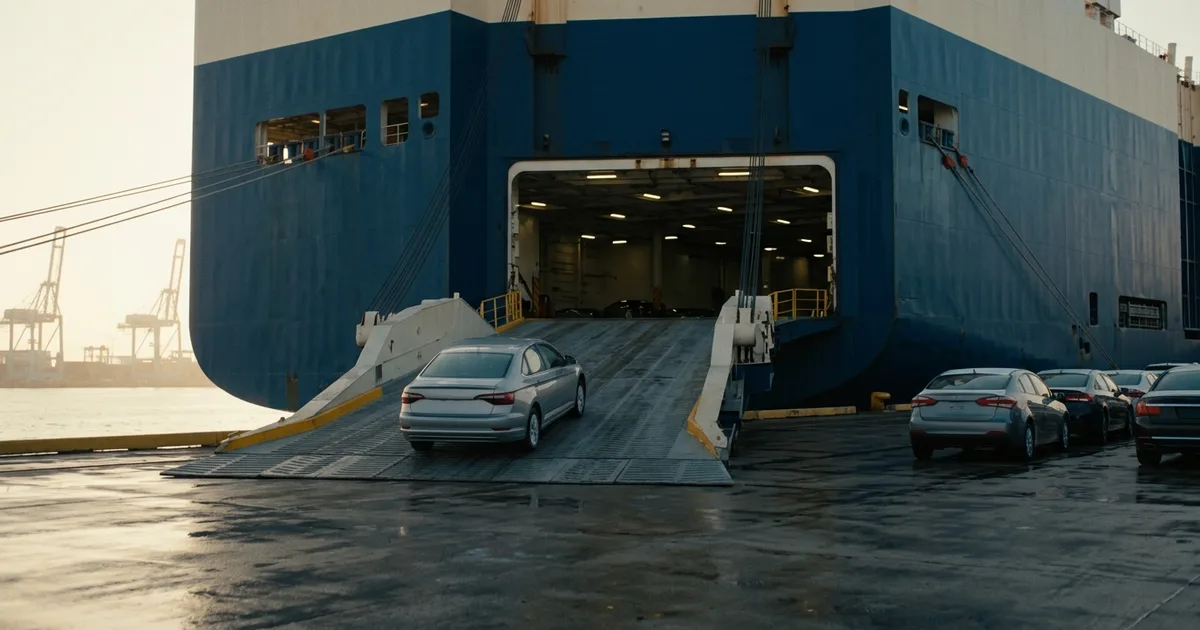

RoRo shipping, short for roll-on roll-off, is ocean transport where a vehicle is driven onto a ship under its own power, lashed to the deck, and driven off at the destination port. It is a widely used method for shipping cars to Hawaii, Alaska and overseas, and usually the cheapest way to move a running vehicle by sea. This guide covers what RoRo is, what to expect before, during and after the voyage, what it costs, which US ports handle it, and the part of the trip that happens on a truck. SAKAEM Logistics is an auto transport broker registered with the FMCSA under MC 16237. We do not book ocean freight; we move cars to and from the port, so this guide is written from the land side of a RoRo shipment, with the ocean side attributed to the lines and forwarders who run it.
Key Takeaways
- RoRo shipping means the car is driven onto the vessel and secured on a deck, so it must be operable and empty of personal items.
- Typical overseas cost for a standard car runs $900 to $2,500 for the ocean leg, per published 2026 broker ranges, with Hawaii and Alaska lanes priced separately.
- Allow roughly 4 to 8 weeks door to door for international shipments, including customs on both ends, and about 1 to 3 weeks on many Hawaii and Alaska routes, depending on origin, sailing schedules and terminal availability, per the forwarders’ and lines’ published timelines.
- Where the US Carriage of Goods by Sea Act governs the bill of lading, the carrier’s liability is generally limited to $500 per package or customary freight unit unless a higher value is declared, so marine cargo insurance is the real protection.
What Is RoRo Shipping?
RoRo shipping is a method of ocean freight in which wheeled cargo is driven on and off a specialised vessel over a ramp, rather than lifted aboard by crane or packed into a container. The ships are floating parking garages: Höegh Autoliners, one of the major lines, describes vessels with up to 14 decks and stern ramps rated for hundreds of tonnes. Cars, trucks, buses, boats on trailers and construction equipment all move this way. For a private owner, RoRo is the default choice for shipping a running car to another country or to Hawaii or Alaska, because it costs less than a container and needs no packing.
What can you ship with RoRo
Any wheeled or tracked vehicle that can move under its own power or be towed: cars, SUVs, pickups, motorcycles, RVs, trailers, tractors and heavy equipment. Two things generally cannot go: personal belongings inside the vehicle, which the lines prohibit for customs and safety reasons, and vehicles that cannot be driven or safely towed aboard. Some lines accept non-running vehicles for a handling fee and forklift loading; many do not, and a container becomes the fallback. Ask the forwarder before booking a non-runner.
RoRo vs container shipping
| RoRo | Container | |
|---|---|---|
| How the car travels | Driven onto a vehicle deck, usually enclosed within the vessel, and lashed for the voyage | Loaded into a 20 ft or 40 ft steel box, blocked and braced |
| Typical cost | Lower; the vehicle is the only unit | Higher; you pay for the box and the loading |
| Personal items | Not allowed | Sometimes allowed; depends on the forwarder, the destination’s customs rules and the insurance |
| Non-running vehicles | Often refused or surcharged | Accepted; forklift-loaded |
| Exposure | Enclosed deck on most car carriers, but shared space and port handling | Sealed box, less handling |
| Sailing frequency | Fixed liner schedules, fewer ports | More ports and departures |
| Best for | Standard running cars, Hawaii, Alaska, most overseas moves | High-value cars, non-runners, cars shipped with belongings |
The cost gap is usually several hundred dollars in RoRo’s favour on the same route; Alaska carriers, for example, price container service $500 to $1,200 above RoRo, as noted on our Alaska car shipping page.
What to Expect When Shipping with RoRo
A RoRo shipment has three parts: getting the car to the port, the voyage, and getting it out of the destination port. The line handles the middle. The two ends are where owners lose time.
Before shipping
Book with a freight forwarder or directly with a line, and get the sailing date in writing; RoRo vessels run on fixed schedules and missing one can mean waiting two weeks for the next. Prepare the documents early: the original title (or a certified copy where a lien exists), a bill of sale if recently purchased, photo ID, and any export power of attorney the forwarder requires. For a used vehicle being exported from the United States, US Customs and Border Protection requires the vehicle and its title to be presented at the port of export at least 72 hours before the ship sails, under 19 CFR 192.2. Miss that window and the car misses the sailing.
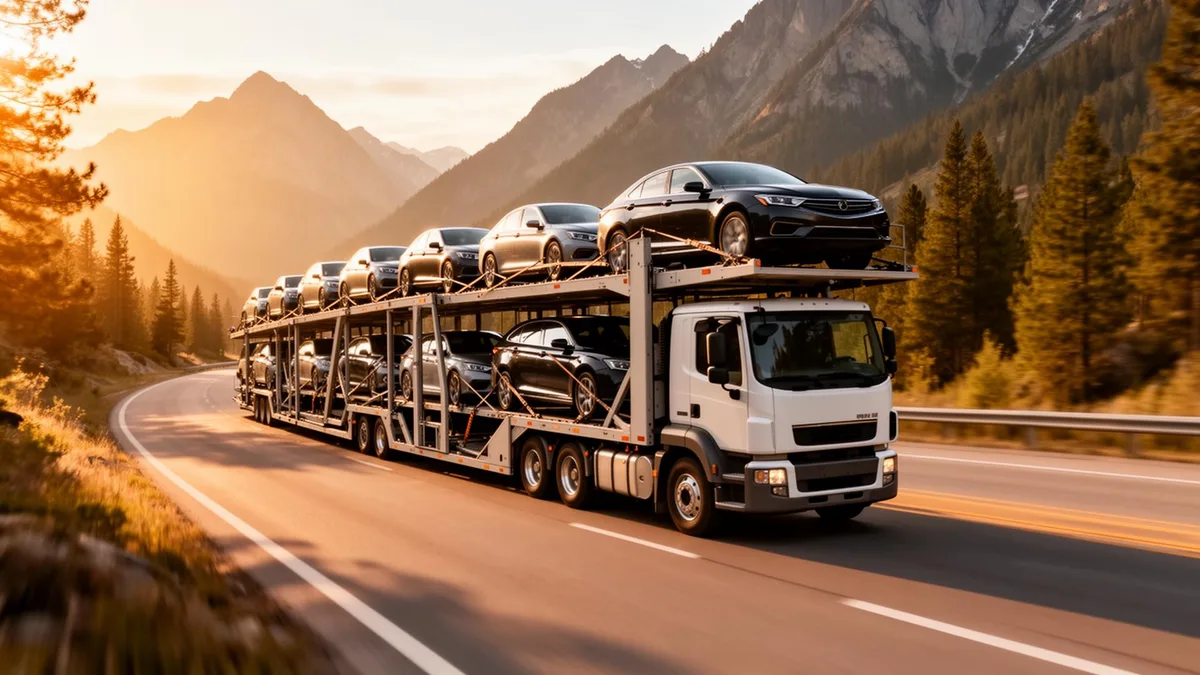
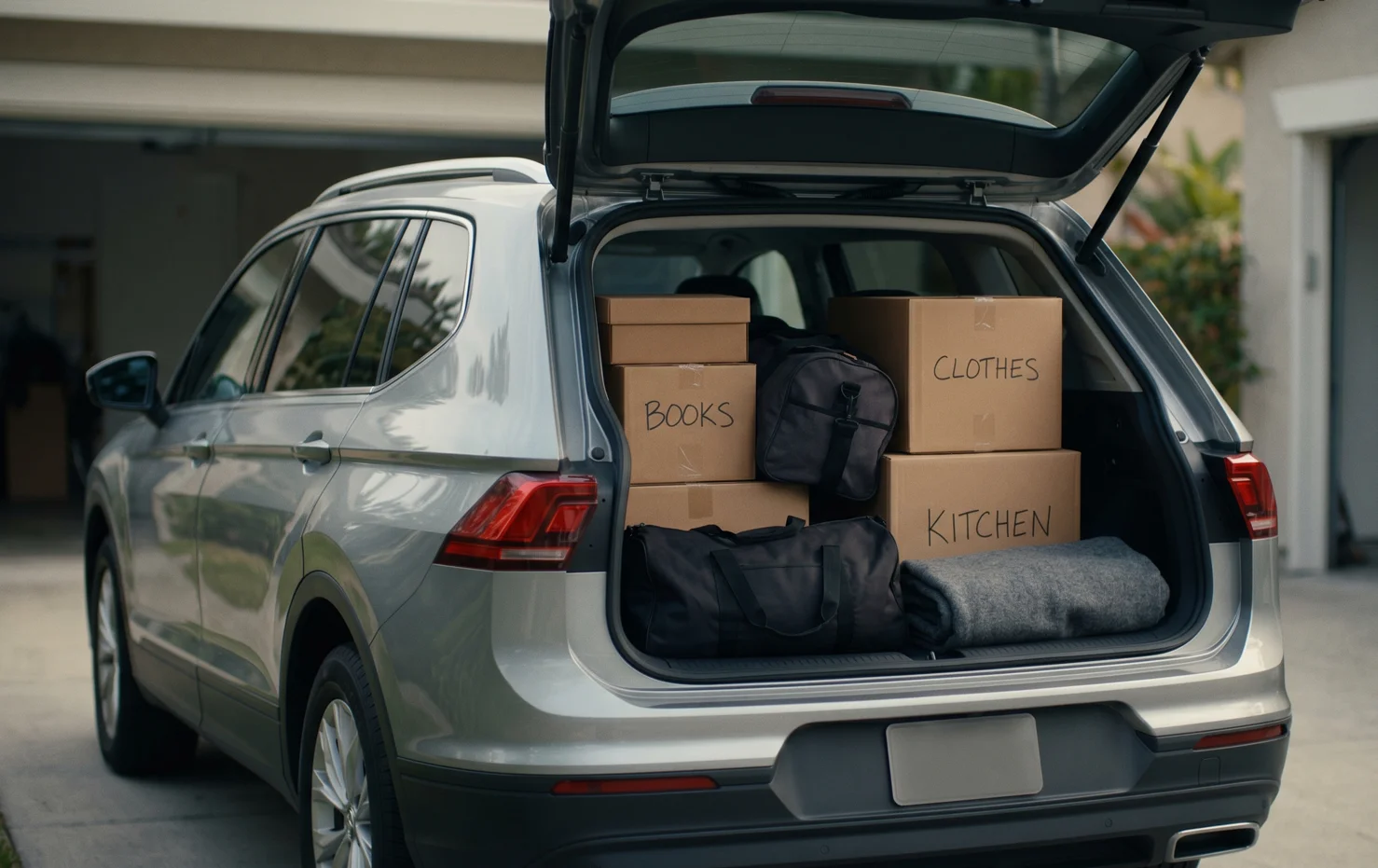
Prepare the car the way the lines require: fuel at a quarter tank or less, no personal items, alarm disabled, loose parts secured, a spare key for the port crew, and photographs of every panel with the odometer visible. The truck leg to the port is where SAKAEM comes in. We dispatch a carrier to your door and deliver the car to the port’s receiving terminal on the date the forwarder gives, which on most domestic lanes means a one-to-three business day pickup window, based on SAKAEM’s dispatch experience. Our guide to car shipping documents covers what the truck driver needs from you at pickup.
What SAKAEM checks before dispatching a car to port
Port deliveries are a small share of our orders and the ones dispatch treats differently, because a terminal is not a driveway. Before a carrier is assigned we confirm three things with the customer and the forwarder. First, the dock receipt or booking confirmation, with the vessel, the booking number and the terminal’s exact receiving address, since a port has several gates and the driver needs the right one. Second, the terminal’s receiving hours and cut-off date; terminals keep business hours, and a truck that arrives after the gate closes or after the cut-off has made a wasted trip. Third, whether the driver needs a TWIC card to enter. Many secure port facilities require a Transportation Worker Identification Credential for unescorted access, and based on our dispatch experience roughly one driver in five in our carrier network holds one, so a TWIC-required delivery has a much smaller pool of trucks and needs more lead time. Settle those three before booking the truck, and the port leg runs like any other delivery.
During shipping
At the port, the terminal inspects the car, records existing damage on a receiving report, and a port driver moves it aboard when the vessel loads. On deck it is lashed to fixed points with straps or chains. Transit times depend on the route: Tacoma to Anchorage runs a few days, the West Coast to Honolulu about a week to ten days, US East Coast to Northern Europe two to three weeks, and longer to the Middle East, Africa or Australia. Updates during the voyage come from the forwarder or the line’s vessel schedule; there is no live view of an individual car at sea, and any company promising one is describing the ship, not your vehicle.
Delivery
At the destination, the car is driven off and held in the port’s lot until customs clears it. Overseas that means import duty, taxes and, in many countries, an inspection; the forwarder or a local customs broker handles the paperwork and the fees are yours. In Hawaii and Alaska there is no customs step, though Hawaii runs an agricultural inspection on arriving vehicles, and the car is usually available for pickup within a day or two of arrival. Inspect the car against your pre-shipment photos before you sign for it, because a claim filed after you leave the port is close to impossible to document. If you want it delivered rather than collected, book the destination truck leg in advance; port storage fees start after a short free period.
Pros of RoRo Car Shipping
RoRo is the standard for a reason, and its advantages hold for most private shipments.
- Lower cost than a container for the same route, since you pay for one vehicle rather than a box.
- Less handling. The car is driven on and off; nothing is lifted or braced.
- Simple preparation. Empty the car, quarter tank, hand over the keys.
- Frequent, predictable sailings on the main US export and Hawaii and Alaska lanes.
- Fits vehicles a container cannot: RVs, lifted trucks, boats on trailers, equipment.
Cons of RoRo Car Shipping
The limits come from the same design: nothing can travel inside the car, the car generally has to run, and the sailing schedule belongs to the line, not to you.
- No personal items. Anything inside the car is a customs problem and a theft risk, and the line will refuse it.
- The car must run, or you pay for special handling, or you switch to a container.
- Shared decks and port handling mean more hands on the car than a sealed container.
- Fixed schedules and fewer ports. If the nearest RoRo port is 600 miles away, the truck leg is part of the price.
- Ocean carriers limit their liability under the bill of lading and maritime law. For shipments governed by the US Carriage of Goods by Sea Act (46 U.S.C. § 30701 note), the default limit is generally $500 per package or customary freight unit unless a higher value is properly declared. Marine cargo insurance, bought through the forwarder, is what actually covers the car.
Cost of RoRo Shipping
RoRo pricing has three layers: the ocean freight, the port and documentation fees on each end, and the truck legs to and from the ports. Published 2026 ranges from US brokers put the ocean leg for a standard car at roughly $900 to $2,500 depending on the destination, per A1 Auto Transport’s July 2026 guide, with Western Europe and West Africa at the low-to-middle of that range and Australia, the Gulf and East Asia higher. Port handling, export documentation and destination customs brokerage typically add several hundred dollars, and import duty is set by the destination country. Motorcycles ship for less; oversized trucks and RVs are priced by the space they occupy on deck.
The domestic RoRo lanes are simpler. SAKAEM’s Hawaii car shipping page lists pricing from about $1,500 and the Alaska page from about $2,400, both starting points for RoRo service out of West Coast ports; the actual quote depends on where the car starts on the mainland, the season and the direction of travel. For comparison, Matson’s published port-to-port rate from Long Beach or Oakland to Honolulu is $1,790 (rates effective June 7, 2026, per Matson’s car shipping page), so a quote that includes a mainland pickup will sit above the ocean rate alone. For any mainland pickup or delivery to a port, the car shipping cost calculator gives the truck-leg estimate on its own.
US RoRo Ports
Most private RoRo shipments leave from a handful of ports, and which one depends on where the car is and where it is going.
| Port | Region | Typical RoRo routes |
|---|---|---|
| Baltimore, MD | Mid-Atlantic | Europe, Middle East, Africa; one of the largest US vehicle ports |
| New York and New Jersey (Newark) | Northeast | Europe, Middle East, West Africa |
| Brunswick, GA and Jacksonville, FL | Southeast | Europe, Caribbean, Puerto Rico, West Africa, South America |
| Houston and Galveston, TX | Gulf | Central and South America, Europe, Middle East |
| Long Beach and Los Angeles, CA | West Coast | Hawaii, Asia, Australia |
| Port Hueneme, CA | West Coast | Asia, Australia, Pacific |
| Tacoma, WA | Pacific Northwest | Alaska, Hawaii, Asia |
Port assignments follow the lines’ published schedules and change with the season; confirm the port and cut-off date with the forwarder before booking the truck. If you are choosing between driving to the port and having the car trucked there, our comparison of terminal-to-terminal car shipping covers the economics of the drop-off option.
The Bottom Line
RoRo shipping is the cheapest and simplest way to move a running car by sea, whether that is to Honolulu, Anchorage or another country, and it comes with two rules: standard service generally requires an operable car, with some operators taking non-runners only with advance approval and special handling, and nothing can be inside it. Budget for the ocean leg, the port fees on both ends, and the truck to and from the port, and buy marine cargo insurance, because the carrier’s liability under a standard bill of lading is generally limited to a few hundred dollars. Since 2017 SAKAEM Logistics has brokered the land side of these moves, delivering cars to port terminals on the forwarder’s date with a carrier whose FMCSA authority and insurance we verify before dispatch, and our customers have left 580+ Google reviews averaging 4.6 stars. If your car needs to get to a port, get a car shipping quote for the truck leg before you book the sailing.
RoRo Shipping FAQ
What is RoRo shipping?
RoRo, or roll-on roll-off, is ocean transport where vehicles are driven onto a ship over a ramp, secured on deck, and driven off at the destination. It is the standard method for shipping running cars overseas and to Hawaii and Alaska.
Is RoRo shipping safe?
RoRo is a mature, routine method, and a running car with nothing inside it is what the lines require rather than a guarantee. The vehicle travels on a deck inside the ship, lashed down, and is handled by port crews at each end. The risks that do occur are minor handling damage and theft of items left in the car, which is why you photograph the car before it ships and insure it for its value.
Does RoRo deliver cars?
No. RoRo is port-to-port. The car is dropped at the departure port and collected at the arrival port. Door-to-door service means a truck leg on each end, arranged separately or through the forwarder, which is the part SAKAEM brokers on the US side.
Is RoRo shipping cheaper than container shipping?
Usually, by several hundred dollars on the same route, because you pay for one vehicle rather than a container and its loading. Container shipping wins when the car does not run, is high-value, or is travelling with personal belongings.
Is insurance included with RoRo shipping?
Rarely in a useful amount. Ocean-carrier liability is usually limited by the bill of lading and maritime law; where the US Carriage of Goods by Sea Act applies, the default is generally $500 per package or customary freight unit unless a higher value is declared. Separate marine cargo insurance, sold by forwarders for a percentage of the declared value, can cover the vehicle’s value, subject to the policy’s terms, exclusions and deductible.
How do I track my vehicle during RoRo shipping?
Through the forwarder and the line’s vessel schedule. You will know which ship the car is on and when it is due, and most lines publish vessel positions. There is no live tracking of an individual vehicle at sea.
How long does RoRo shipping take?
The voyage itself runs from a few days (Tacoma to Anchorage) to a week or so (West Coast to Hawaii) to two to three weeks (East Coast to Europe) and longer to Australia or the Middle East. Door to door, including the truck to port, port processing and customs, plan on 4 to 8 weeks overseas and 1 to 3 weeks for Hawaii or Alaska.
What documents do I need for RoRo shipping?
For a US export: the original title or a certified copy, a bill of sale if recently bought, photo ID, and the forwarder’s shipping form or power of attorney. CBP requires the vehicle and title to be presented at the port at least 72 hours before departure. Hawaii and Alaska shipments need the title or registration and ID, with no customs filing.