

Trading in a car in 2026 looks different than it did two years ago. Negative equity has hit record highs — 28.1% of new-car trade-ins now carry an upside-down loan averaging $6,905, per Edmunds Q3 2025 data. Used-car loan rates sit near 11% APR, online buyers like Carvana and CarMax compete head-to-head with dealers, and trade-in tax credit rules vary enough by state to swing your bottom-line cost by thousands. This guide walks every step — valuation, prep, negotiation, paperwork, and shipping the trade-in if it lives in another state.
Key Takeaways
- Get three written offers before you set foot at the dealership: KBB, Carvana, and CarMax all give instant numbers in under five minutes.
- Most states (37 of them) only tax the difference between your new car price and your trade-in, which can save $1,500–$3,000 on a typical purchase. California, Virginia, Hawaii, Maryland, Michigan, Kentucky, and the District of Columbia limit or exclude this benefit.
- Negotiate the new car price first, then the trade-in — bundling them lets dealers shift profit between the two.
- If you owe more than the car is worth (negative equity), do not roll the difference into the new loan unless you have to. Buyers who roll negative equity pay $140 more per month on average.
How Does Trading in Your Vehicle Work?
Trading in a car in 2026 comes down to three things: pulling an honest value on your existing vehicle, locking in a tax-credit-eligible new purchase, and making the dealer compete with online buyers. The dealership credits your trade-in value against the new car, reducing what you finance or pay in cash. In most states, that credit also reduces sales tax — a saving private sales and online buyers cannot match. Before committing either way, the best used car websites are worth a scan to benchmark both your trade-in’s retail value and what your replacement should cost.
The math at signing: (New car price) − (Trade-in value) + (Sales tax on the difference) + (Fees) − (Down payment) = Amount financed. If your old loan is not paid off, the dealership pays the balance directly with your lender. Positive equity rolls into your down payment; negative equity rolls into the new loan unless you close the gap with cash.
According to the 16th annual Cox Automotive Car Buyer Journey Study released January 2026, getting a trade-in offer ranks among the five most stressful steps in buying a car. The fix is preparation: walk in with three competing written offers and you flip the dynamic.
Determine Car Value
Start with two free valuation tools that dealers themselves reference: Kelley Blue Book and Edmunds. Both ask for your VIN, mileage, condition, and zip code, then return three figures — trade-in value, private-party value, and dealer retail value. The trade-in value is your floor; anything below it is a lowball — though it pays to understand how accurate KBB’s numbers really are before you anchor on them.
Then collect three real offers in writing:
- Carvana online instant offer (carvana.com)
- CarMax online or in-person appraisal (good for seven days, holds for 500 miles)
- One local dealership where you actually want to buy
The Carvana and CarMax numbers set a market floor. A dealer who knows you have $14,500 from CarMax in your phone will not offer $11,000 with a straight face. Our guide on how to find the value of a car covers depreciation curves and condition tiers in depth.
Prepare Car for Trade in
Appraisers form an impression in the first 60 seconds. Spend $20–$50 and one Saturday on these:
- Wash and vacuum the interior; clean the windows; wipe down hard surfaces
- Remove all personal items, paperwork, and aftermarket add-ons (window tint film, decals, custom shift knobs)
- Replace burned-out bulbs and a missing cabin air filter — a $30 fix that signals maintenance discipline
- Touch up small paint chips with a manufacturer touch-up pen if the panel is otherwise clean
- Pull together service records, oil-change receipts, and the original owner’s manual
What not to do: invest in body work, new tires, or detailing services that cost more than $100. Recon is what dealerships do for a living — they will pay for it themselves and adjust your offer accordingly. You only get the recon savings credited if your work was free.
Shop Offers
Take your three written offers and do one of two things:
- Email or text the offers to two more local dealers and ask for their best number
- Show up at your top-choice dealer with the offers visible and ask if they will match or beat them
Offers expire. CarMax holds for seven days. Carvana holds for seven days but is subject to revision at pickup if the inspector finds anything that does not match your description (revisions typically run $200–$3,000). Most dealer offers hold 48–72 hours. Move quickly once you have your floor set.
Negotiate a Deal
Two rules carry the entire negotiation:
- Settle the new car’s out-the-door price before the trade-in number comes up. Dealers can shift profit between the two figures; isolating each negotiation prevents that.
- Trade-in values are negotiable. A 10–15% bump from the appraiser’s first number is realistic when you have competing offers in hand.
Watch for the four-square sheet — a worksheet split into trade-in value, new car price, monthly payment, and down payment. Dealers shift money between boxes to make the deal “look better” on the box you focus on. Stay anchored on the out-the-door total, not the monthly payment.
If the dealer will not match your CarMax number, sell to CarMax, take the check, and buy the new car cash-equivalent. You give up the tax-credit savings but gain leverage. On trade-ins we coordinate, the dealer’s first offer commonly lifts $1,000–$2,000 the moment a CarMax quote lands on the table — and stays flat when it does not.
Close the Transaction
The paperwork moves fast — slow it down. You will sign:
- Bill of sale for the trade-in
- Power of attorney so the dealer can transfer the title with your state DMV
- Loan payoff authorization if there is an existing balance
- Purchase agreement and finance contract for the new car
Read every line item. Common surprise charges include doc fees ($75–$995 depending on state), VIN etching ($200–$400, decline it), nitrogen-filled tires, and fabric protection. None of these add real value; all are negotiable or refusable.
If you are financing, compare the dealer’s rate to a pre-approval from your bank or credit union. As of Q1 2026, average new-car APRs sit at 7.02% and used-car APRs at 11% per Bankrate and Edmunds. Buyers with super-prime credit see 4.66% on new cars; deep-subprime borrowers can see 16% or higher.
Update Insurance
Call your insurance carrier the same day the title transfers. Most policies offer a 7–30 day grace period only if the company is notified. Drop the trade-in, add the new vehicle, and confirm coverage in writing. If you are financing at 72–84 months, ask about gap insurance — at $20–$60 per year, it covers the difference between your loan balance and the car’s value if it is totaled, which matters most in the early years of negative-equity territory.
What is Needed to Trade in Your Car?
Bring a single folder with everything below. Missing one document can stall the deal by days.
- Vehicle title (or your lender’s payoff letter if the car is financed)
- Current registration
- Both sets of keys and key fobs (a missing fob can knock $300–$500 off the offer)
- Driver’s license
- Proof of current insurance
- Last two pay stubs or proof of income (for new-car financing)
- Service and repair records
- Owner’s manual and any spare wheel locks
- Loan account number and payoff amount, if applicable
In community-property states (AZ, CA, ID, LA, NV, NM, TX, WA, WI), the title may require both spouses’ signatures even if only one name is on it. Verify with your DMV before the appointment.
What Most Buyers Miss: Insider Insights
Five things that move the trade-in number more than buyers expect:
- Timing beats appearance. Trading the week before a major service interval (60K-mile, 100K-mile, transmission flush) captures resale value before the dealership discounts for upcoming reconditioning they will have to absorb. A clean car at 95,000 miles trades for hundreds more than the same car at 100,500. Same vehicle, different week, different number.
- Most trade-ins never touch the dealer’s lot. A large share of dealer trade-ins move directly to wholesale auctions like Manheim and ADESA rather than the dealer’s own retail inventory. That means dealers price your trade at auction wholesale, not the retail prices you see on their lot. The gap between wholesale and retail is typically 15–25% — and that is your negotiation room.
- Why CarMax sometimes overpays. CarMax operates on a no-haggle, seven-day return model that requires quick inventory turnover. On vehicles they expect to retail within 30 days — late-model Toyotas, Hondas, Subarus, popular SUVs — they will sometimes pay above wholesale to lock supply. Pull a CarMax offer on these vehicle types specifically; they often beat dealer trade quotes.
- Color is worth more than buyers think. White, black, and silver consistently get higher commuter-car offers because they retail faster from dealer lots. Red, blue, and performance-segment colors command premiums on sports cars and coupes. Off-trend colors (yellow, lime, brown) drop wholesale offers 5–10% on the same VIN.
- The biggest single mistake is psychology, not paperwork. Buyers who walk in with one offer in their phone get one offer back. Buyers who walk in with three offers get a real negotiation. The mechanical steps are identical; the leverage is night and day.
Trade-In vs Carvana vs CarMax vs Selling Privately
Think of a dealer trade-in as wholesale liquidation, not a sale — dealers price your car for the auction lane, not their lot. That framing changes how you read every offer. Each option pays differently, takes different time, and carries different risk.
| Option | Typical Payout | Time to Cash | Tax Credit | Best For |
|---|---|---|---|---|
| Dealer trade-in | 80–90% of KBB private-party | Same day | Yes (37 states) | Buyers replacing the car immediately |
| CarMax | 90–95% of KBB private-party | Same day | No (separate sale) | Sellers wanting a guaranteed offer |
| Carvana | 85–95% of KBB private-party | 1–3 days (pickup) | No | Sellers who want pickup at home |
| Private sale | 95–100% of KBB private-party | 2–8 weeks | No | Sellers willing to handle test drives, paperwork, payment risk |
Real-world example on a 2022 Toyota Camry SE with 38,000 miles, KBB private-party value $22,500:
- Dealer trade-in offer: $19,500 (87% of KBB)
- CarMax instant offer: $20,800 (92%)
- Carvana instant offer: $20,200 (90%)
- Private-party sale: $22,000 (98%, after one month of listings)
In a state with a 7% sales tax that grants the trade-in credit, taking the $19,500 trade-in on a $35,000 new car saves $1,365 in sales tax versus selling privately and buying separately. The trade-in’s effective value rises to $20,865 — closer to the CarMax number than it appears at first. Buyers we work with consistently underestimate one thing: the tax credit alone closes 60–70% of the gap between dealer trade and private-party price in most states. In states without the credit (California, Virginia, Hawaii, Maryland, DC), that math evaporates and the highest cash offer wins.
FinanceBuzz tracked 100+ vehicles and found CarMax wins 63% of head-to-head comparisons, averaging $1,000 more. The 2024–2026 follow-up shows the spread at $500–$1,500, with Carvana now leading on newer high-demand cars. Always pull both numbers.
The honest take: in no-credit states (California, Virginia, Hawaii, Maryland, DC, Kentucky), trade-ins are almost always a worse deal than selling to CarMax outright. The only reason to trade in those states is convenience — one transaction, same day, paperwork handled. Everywhere else, the tax credit math usually wins.
If you decide to sell instead of trade, our Carvana review breaks down the seven-day return policy, pickup logistics, and inspection adjustments, and our CarMax selling guide covers the 500-mile offer cap and same-day payment options.
Trade-In Tax Credit by State: Where the Real Savings Live
Most states tax only the difference between your new car price and your trade-in value. A handful tax the full new-car price regardless. The difference can swing your total cost by thousands.
| State Treatment | States | Savings on $35K Purchase + $20K Trade |
|---|---|---|
| Full credit (tax on difference only) | 37 states including TX, FL, GA, IL, NY, OH, PA, NJ | $1,200–$2,000 saved |
| No credit (tax on full price) | California, Virginia, Hawaii, Maryland, District of Columbia, Kentucky | $0 saved |
| Capped credit | Michigan ($10,000 cap) | Partial saving |
| New-car only | Ohio (used purchases excluded) | Saving on new only |
To calculate your specific saving: trade-in value × your state sales tax rate = the dollars staying in your pocket. On a $20,000 trade-in at 7% sales tax, that is $1,400 — straight money the IRS does not collect.
This rule changes the math on whether to trade in or sell privately. In a no-credit state like California, the private-buyer’s higher sale price is yours to keep. In a full-credit state like Texas, the trade-in’s tax saving often closes 60–70% of the gap to the private-party number. Run the math before you decide.
For the official treatment in your state, check your state department of revenue or the IRS used clean vehicle credit page for federal EV-specific rules layered on top.
EV Trade-Ins: Federal Credit Stacks on State Rules
If you are buying a used EV, federal incentives stack on top of the state trade-in credit. The Inflation Reduction Act’s Used Clean Vehicle Credit — up to $4,000 — became transferable at point of sale in January 2024, so the dealer applies it directly to your price rather than making you wait until tax filing. Income limits: $75,000 single, $112,500 head of household, $150,000 joint. The vehicle must be priced under $25,000, at least two model years old, and bought from a registered dealer.
The harder reality: used EVs are depreciating faster than gas vehicles in 2026. EV trade-in offers run 15–25% below comparable internal-combustion vehicles due to battery-degradation concerns and a glut of off-lease inventory. If you are trading in an EV, run the math both ways before deciding.
When Out-of-State Dealerships Beat Local: Shipping the Trade-In
Sometimes the best deal is not the dealership down the street. Inventory shortages, regional pricing, and state tax differences mean buyers regularly save $1,500–$4,000 by purchasing 500–1,500 miles from home. Our breakdown of the cheapest states to buy a car covers the seven states with the lowest combined sticker-plus-tax pricing.
The catch: the trade-in lives where you live, and the new car lives where the dealer is. You have three options.
- Drive both directions. Practical for trips under 400 miles; not practical for cross-country.
- Have the trade-in sold privately or to CarMax locally before you fly out. This works but loses you the trade-in tax credit.
- Ship the trade-in to the dealer and take delivery of the new car on the same trip.
Shipping the trade-in is usually the cleanest play. Most cross-state trade-ins we coordinate fall into three buckets: individual buyers chasing a better deal in another market, snowbirds settling cross-country relocations, and dealers managing inventory acquisition. A typical 1,000-mile open-carrier transport runs $750–$1,100, takes 5–7 days, and lets the dealership process your trade-in on arrival. For pricing on your specific route, see our full breakdown of the cost to ship a car or request a free quote.
Concrete scenario: a Detroit buyer flies to Phoenix to take delivery of a $42,000 Tacoma at $2,200 below the Detroit market price. Their 2019 Honda CR-V trade-in is worth $18,500 in Phoenix. Open transport Detroit-to-Phoenix runs about $950. The buyer nets $1,250 ahead even after shipping — and pockets the $1,295 Phoenix sales tax credit on the trade-in. That is roughly $2,545 in real savings versus closing the deal locally.
How Much Does It Cost to Ship a Trade-In Vehicle?
Three variables drive shipping cost: the car’s condition, the method, and the company.
Operable vs Inoperable Cars
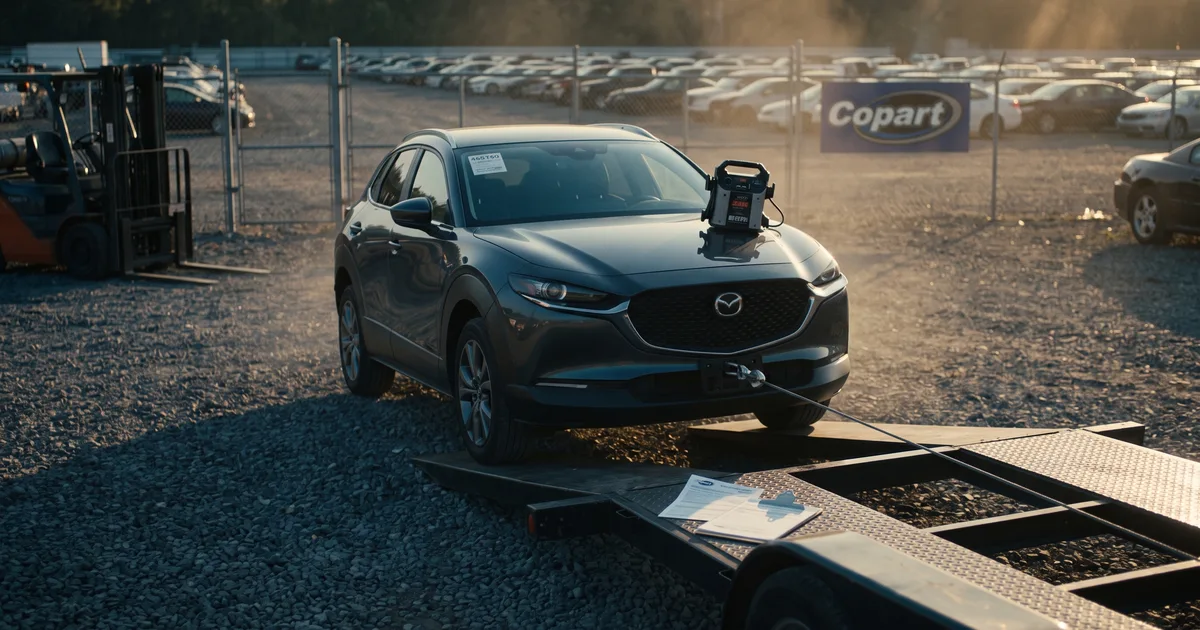
A running vehicle costs the standard rate. An inoperable vehicle — bad battery, flat tires, engine or transmission issues — adds $150–$300 because the carrier needs a winch and extra time. Be honest about condition: a misclassified inoperable car can be refused at pickup, costing you a redispatch fee.
Mode of Shipping
Open transport carries 7–10 cars on an exposed multi-car trailer and is the standard for trade-ins. Pricing for a 1,000-mile move runs $750–$1,100. Enclosed transport protects the vehicle inside a covered trailer and is worth the 50–70% premium for classics, exotics, and luxury cars over $80,000. For a routine trade-in, open is the right call. Our full guide on open versus enclosed transport breaks down the tradeoffs.
Type of Shipping Company
Working with a licensed broker puts your shipment in front of a wide carrier network at market-rate pricing. Direct carrier quotes reflect one truck’s availability and usually run higher. Dealerships sometimes offer shipping but mark it up. Booking yourself almost always costs less.
Every carrier we dispatch goes through three checks: USDOT and MC numbers cross-referenced with FMCSA records, current certificate of insurance with you listed as certificate holder, and a safety record review covering drug, alcohol, hours-of-service, and crash history.
Bottom Line
Trading in a car in 2026 rewards preparation. Pull three offers before you negotiate. Settle the new car price first. Use the tax credit if your state honors it. Shop the dealership down the street and the dealership 1,200 miles away — and ship the trade-in if the math works.
When you are ready to move a trade-in across the country, SAKAEM handles the logistics. Open and enclosed transport, door-to-door pickup, and 1–3 day pickup windows nationwide. Get a free quote or call us — we will match the carrier to your timeline and route, and your trade-in arrives in the same condition it left.
Vehicle Trade-In FAQ
Can you trade in a financed car?
Yes, you can trade in a financed car. The dealership pays off the existing loan directly with your lender at closing. If the trade-in value exceeds the payoff amount, the difference becomes positive equity and reduces what you finance on the new car. If the payoff exceeds the trade-in value, the negative equity rolls into the new loan unless you bring cash to close the gap.
When should you trade in a car?
Trade in when you have positive equity and the car is still in service-friendly territory — before major maintenance milestones at 60,000, 100,000, or 150,000 miles. Spring and early fall historically deliver the highest offers because dealers need inventory to match buyer demand.
At what age is the best time to trade in a car?
The 3–4 year mark is the sweet spot for most non-luxury vehicles. The steepest depreciation curve has flattened, the factory warranty is winding down, and dealers value the car for certified pre-owned (CPO) reconditioning. Year five or later drops you into second-tier auction inventory where offers thin out.
What is the best mileage to sell a car?
For most cars, 30,000–60,000 miles is the highest-value band. The vehicle still qualifies for CPO programs, the powertrain warranty often has time remaining, and dealers can retail it without major reconditioning. After 100,000 miles, offers drop sharply — the car typically heads to wholesale auction.
Are trade-in values negotiable?
Yes. The first appraisal is rarely the final number. With CarMax or Carvana offers in hand, a 10–15% bump from the dealer’s opening number is achievable. Negotiate the trade-in separately from the new car price.
What is the trade-in tax credit?
The trade-in tax credit is the sales tax savings 37 states grant when you trade in a vehicle. Instead of paying tax on the full new-car price, you pay tax on the difference between the new car and your trade-in value. On a $35,000 purchase with a $20,000 trade-in at 7% sales tax, the credit saves $1,400. California, Virginia, Hawaii, Maryland, DC, and Kentucky do not grant the credit; Michigan caps it at $10,000.
Should I trade in or sell to Carvana or CarMax instead?
Depends on your state’s tax rules. With the trade-in credit, the dealership’s lower offer often nets within $500–$1,000 of CarMax after the tax saving. In a no-credit state, the highest cash offer wins. Pull all three numbers before deciding.
What if my car has mechanical problems?
Disclose every issue up front — surprises at appraisal lead to lower offers or canceled deals. Major issues (transmission, head gasket, frame damage) drop the offer 30–60%. If the repair costs more than the value lift, sell as-is.
Can I trade in a leased car?
Yes, with caveats. If your lease buyout (residual plus payoff fee) is less than the trade-in value, you have positive equity. If the buyout exceeds it, bring cash to close the gap. Some leasing companies restrict trade-ins to brand-affiliated dealerships — check your contract.
What documents do I need at the dealership?
Bring the title or lender payoff letter, current registration, both sets of keys, your driver’s license, proof of insurance, recent service records, the owner’s manual, and the loan account number if applicable. Missing the second key fob alone can drop the offer $300–$500.
Will the dealership pay for shipping if the trade-in is in another state?
Some will, but they typically build the cost into the new-car price or the trade-in offer. Booking your own transport through a licensed broker almost always costs less and gives you more control over timing.
What is negative equity and what should I do about it?
Negative equity means you owe more than the car is worth. As of Q3 2025, 28.1% of trade-ins carry negative equity averaging $6,905 per Edmunds. Rolling it into a new loan adds $140 per month on average. Better: bring cash to close the gap, hold until you have positive equity, or refinance to a shorter term.