
Open Vs. Enclosed Car Shipping — What’s the Difference?
Open and enclosed are the two ways the U.S. auto transport industry moves vehicles between locations, and the choice between them comes down to cost, protection, and what kind of car is on the trailer. Roughly 90% of the more than 12 million vehicles transported each year by FMCSA-licensed carriers move on open trailers because the math favors them for everyday cars. Enclosed trailers exist for the other 10% — luxury, classic, exotic, low-clearance, and high-value vehicles that can’t tolerate weather or road debris. This guide from SAKAEM Logistics, an FMCSA-licensed auto transport broker (MC-16237) with over 300,000 vehicles shipped, explains how each method works in 2026, what each costs, what insurance covers each, and how to pick the right one for your specific vehicle.
Open vs. Enclosed at a Glance
| Factor | Open Transport | Enclosed Transport |
|---|---|---|
| Typical cost (cross-country) | $900–$1,500 | $1,400–$2,800 |
| Cost premium vs open | Baseline | +30–60% |
| Vehicles per trailer | 7–10 | 2–6 (or 1) |
| Cargo insurance per shipment | $100K–$250K | $250K–$1M+ |
| Weather and debris exposure | Yes | None |
| Liftgate loading | Rare | Common |
| Pickup window | 1–5 days | 3–10 days |
| Best for | Everyday cars, daily drivers, standard SUVs | Luxury, classic, exotic, EVs, lowered, inoperable |
| Share of U.S. shipments | ~90% | ~10% |
Key Takeaways
- Open transport costs $550–$1,200 for most cross-country shipments; enclosed runs 30–60% more, typically $900–$2,400.
- Open carriers move 7–10 vehicles at once with cargo insurance usually capped at $100K–$250K per shipment; enclosed haul 2–6 vehicles with $250K–$1M+ coverage.
- Enclosed is required practical sense for any vehicle valued above $75K, lowered or modified rides, classic and exotic cars, and most non-running vehicles needing a liftgate.
- The fastest path to an accurate quote is a route-specific estimate built from real recent shipment data, not a generic distance-times-rate calculation.
What is Open Car Transport?
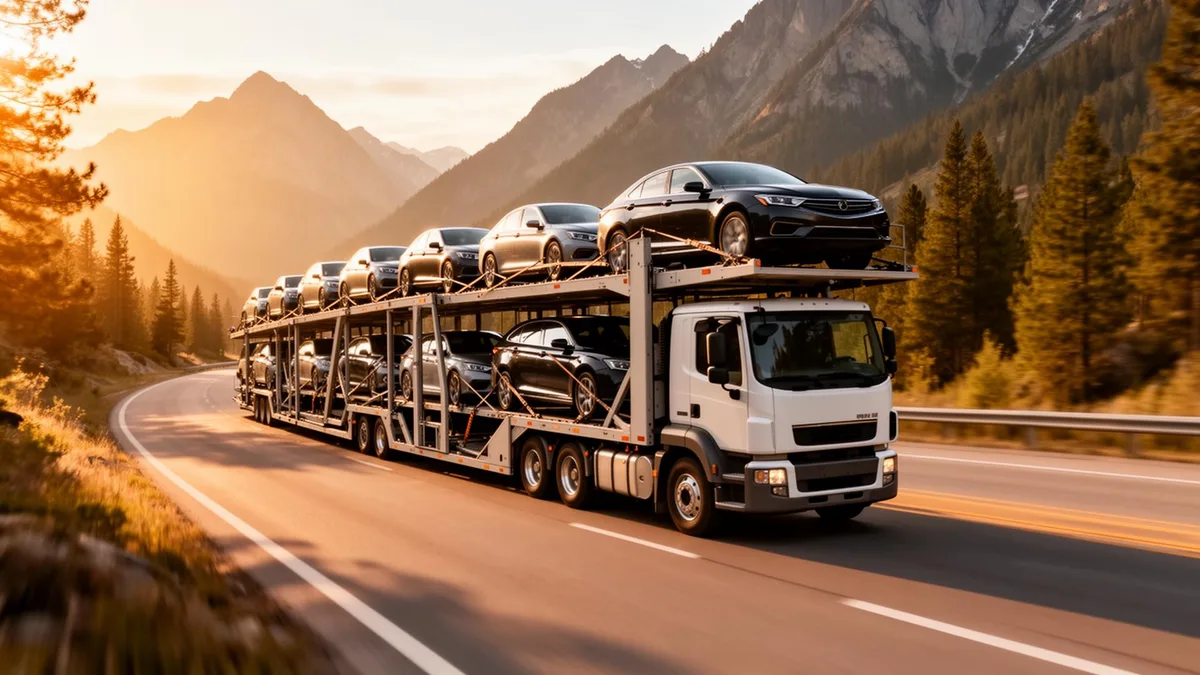
Open car transport ships your vehicle on a multi-level open-air trailer — the same kind you see hauling new cars from manufacturer to dealership. The trailer has a steel frame and tie-down points but no roof or walls, so vehicles travel exposed to weather, road debris, and dust.
Most open trailers carry 7 to 10 vehicles. The driver picks up your car at your specified location, secures it with industry-standard wheel straps, and delivers it to your destination — typically door-to-door, rarely terminal-to-terminal since true terminals have become uncommon. The route is shared with other vehicles going in similar directions, which is what keeps the per-vehicle cost low.
Benefits of Using Open Car Transport
- Lowest cost. Open transport is the most affordable shipping method because the trailer carries multiple vehicles and runs on standard fuel-efficient routes.
- Faster pickup. Open carriers operate the largest fleet on U.S. highways, so dispatch times are usually shorter than enclosed — often within 1–5 days of booking.
- Wide route availability. Because of the volume of open carriers, almost any U.S. origin and destination can be served quickly, including remote pickups.
- Same FMCSA insurance requirements. Open carriers carry the same federally mandated cargo insurance as enclosed (minimum $100,000 in most cases, often higher), so your vehicle is protected from carrier-caused damage either way.
What is Enclosed Car Transport?
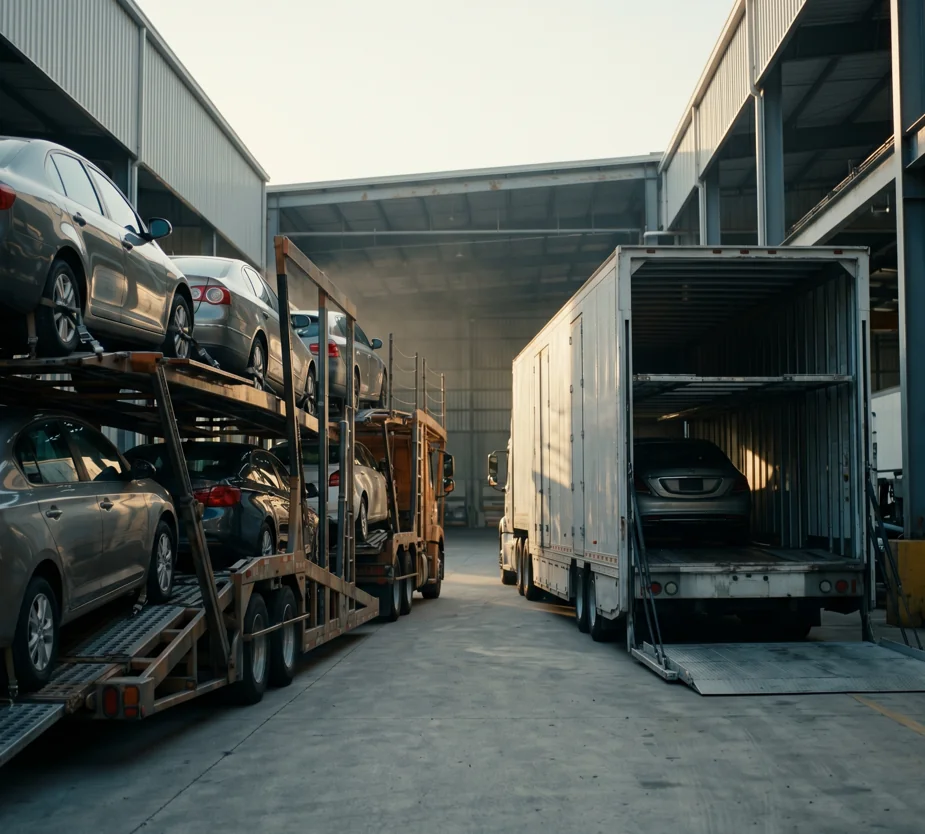
Enclosed car transport ships your vehicle inside a fully enclosed trailer — either a soft-sided trailer made of reinforced canvas over a steel frame, or a hard-sided trailer with rigid metal walls. Enclosed trailers shield vehicles completely from rain, snow, salt, road debris, and prying eyes during transit.
Capacity is much lower than open: most enclosed trailers carry 2 to 6 vehicles. Genuine single-car trailers are mostly a short-haul and specialist product — on long-haul lanes, even exotic and supercar shipments ride the multi-car enclosed network. Enclosed shipments often include hydraulic liftgates instead of ramps, which matters for low-clearance cars that would otherwise scrape on a standard ramp.
Benefits of Using Enclosed Car Transport
- Maximum protection. Vehicles travel completely shielded from weather, debris, and curious eyes — important for anything where a single rock chip would be a costly repair.
- Higher cargo insurance limits. Enclosed carriers typically carry $250,000 to $1 million or more in cargo insurance per shipment, reflecting the higher value of cars they handle.
- Liftgate loading. Most enclosed trailers offer hydraulic liftgate loading, eliminating ramp-clearance issues for lowered, classic, or exotic vehicles.
- Soft-strap tie-downs. Enclosed carriers use soft straps that wrap the wheels rather than chains on the frame, preventing scuffs and stress on classic suspensions.
- White-glove handling. Enclosed drivers move fewer vehicles per trip and typically have specialized training for high-value cars.
Types of Enclosed Trailers
Soft-sided enclosed trailers use a heavy-duty canvas or fabric panel system over a steel frame. They protect from weather and debris while being lighter and more fuel-efficient than hard-sided. Best for most luxury and classic cars at a moderate premium over open transport.
Hard-sided enclosed trailers are fully rigid, climate-controllable, and often air-ride suspension equipped. They’re the gold standard for exotic, museum-quality, and seven-figure vehicles. Cost runs the highest in the enclosed category.
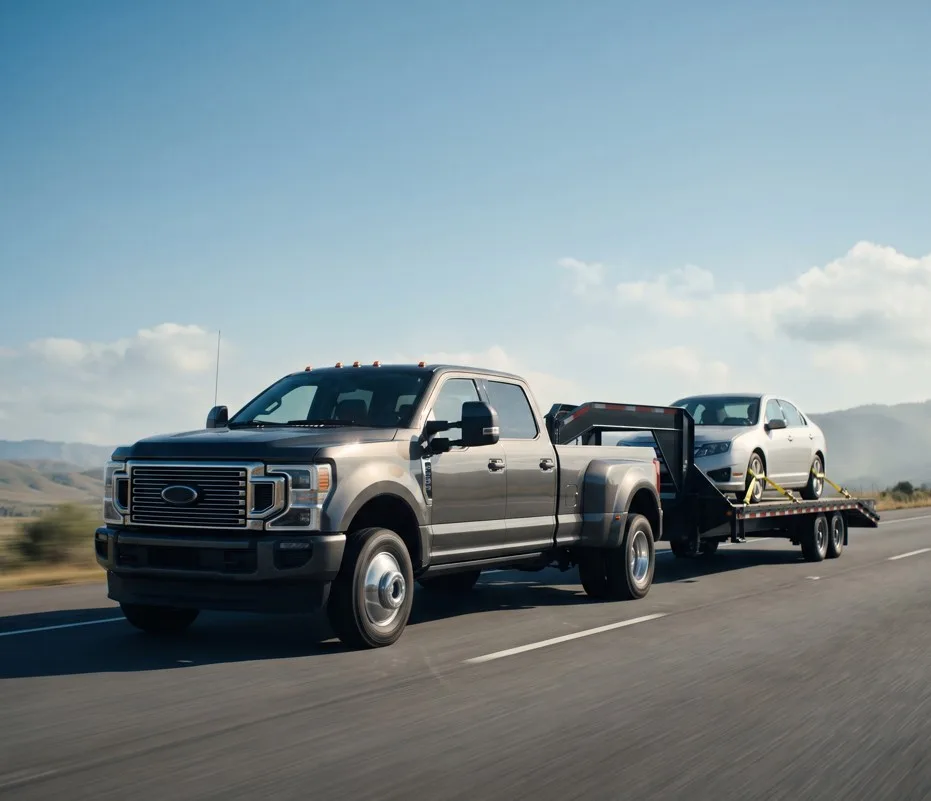
Single-car enclosed trailers carry one vehicle, usually with a fully padded interior and hydraulic lift. Used for million-dollar exotics and irreplaceable classics where any contact with another vehicle is unacceptable.
Cost of Open vs. Enclosed Car Transport
Pricing depends on three primary factors: distance, vehicle dimensions and weight, and current market supply and demand on the route. The numbers below reflect 2026 market rates from SAKAEM’s network of vetted carriers. For a deeper look at what drives auto transport pricing, see our full cost-to-ship-a-car guide.
Cost by Distance (Open vs. Enclosed)
| Distance | Open Transport | Enclosed Transport | Premium |
|---|---|---|---|
| Under 500 miles | $400–$700 | $700–$1,150 | ~60% |
| 500–1,000 miles | $600–$900 | $900–$1,500 | ~55% |
| 1,000–1,500 miles | $750–$1,100 | $1,200–$1,900 | ~60% |
| 1,500+ miles (cross-country) | $900–$1,500 | $1,400–$2,800 | ~50% |
Cost by Vehicle Type
| Vehicle Type | Open Transport | Enclosed Transport |
|---|---|---|
| Sedan / compact car | $550–$900 | $900–$1,400 |
| Mid-size SUV | $700–$1,100 | $1,200–$1,800 |
| Pickup truck (full-size) | $750–$1,200 | $1,300–$2,000 |
| Luxury sedan or coupe | $700–$1,100 | $1,300–$2,200 |
| Classic or exotic vehicle | $800–$1,200 | $1,500–$3,500+ |
| Electric vehicle | $700–$1,150 | $1,300–$2,100 |
| Lifted truck / oversized | $900–$1,400 | $1,800–$3,000+ |
Seasonal demand matters. Winter snowbird routes (Northeast → Florida, Midwest → Arizona) can run 15–25% above these ranges between November and April. Summer relocations add a similar premium on family-move corridors. The accurate way to price your specific shipment is with a real-time quote that pulls actual recent data on your origin-destination pair.
Insurance Coverage Differences
Every FMCSA-licensed carrier is federally required to carry cargo insurance, but the coverage limits between open and enclosed carriers reflect the value of vehicles each typically hauls.
Typical Cargo Insurance Coverage Ranges
Open carriers: Most open transporters carry $100,000 to $250,000 in cargo insurance per shipment, distributed across all vehicles on the trailer. For a typical 9-car open hauler, that translates to roughly $11,000 to $28,000 of coverage per vehicle — enough for most everyday cars but potentially insufficient for a high-value vehicle riding alongside others.
Enclosed carriers: Enclosed transporters typically carry $250,000 to $1,000,000+ per shipment. With only 2–6 vehicles on board, that means $40,000 to $500,000 of coverage per vehicle — appropriate for the luxury, classic, and exotic cars enclosed trailers usually carry.
What Cargo Insurance Covers
Cargo insurance covers physical damage caused by the carrier during transport. Examples:
- Strap or chain marks from improper tie-down
- Accidental scrapes from loading/unloading
- Weather-related damage in transit (varies by carrier)
- Damage from an at-fault accident on the carrier’s part
- Cargo shifts or impacts inside the trailer
What Cargo Insurance Doesn’t Cover
| Excluded | Why |
|---|---|
| Pre-existing damage | Documented at pickup on the bill of lading — gets excluded from any later claim |
| Personal items inside the vehicle | Cargo coverage applies to the vehicle, not contents |
| ”Acts of God” (in some policies) | Hail, falling trees, etc. — verify per-carrier policy |
| Mechanical failures | Not physical damage; covered by your own warranty/insurance |
| Damage during loading by you | Some carriers require their drivers to load; check before loading yourself |
Verifying Insurance Before Pickup
Before any vehicle is loaded, you have the right to ask for the carrier’s certificate of insurance (COI). A reputable broker will provide it without hesitation — the COI shows the carrier’s policy number, coverage limits, and effective dates. If a carrier or broker refuses to share a COI, that’s a red flag.
Special Cases — When the Default Choice Doesn’t Apply
Most everyday cars ship fine on open trailers. These specific scenarios require enclosed or specialized handling regardless of vehicle value:
Electric vehicles (EVs): Most EVs are heavier than equivalent gas vehicles (battery weight) and may exceed open trailer per-vehicle weight limits. Many carriers also require EVs to ship at 50% or lower battery state of charge for safety. Confirm with your broker which carriers in their network handle EVs and what the battery requirement is.
Lowered or modified vehicles: Cars with aftermarket suspension that drops ride height below stock often can’t clear standard open-trailer ramps. Enclosed transport with a hydraulic liftgate is usually required to load them safely without scraping the splitter or undercarriage.
Inoperable vehicles: Cars that don’t run, won’t start, or have damaged steering/brakes need a winch-equipped carrier and often a liftgate. Most open carriers can handle a non-running vehicle if it can roll, brake, and steer; otherwise enclosed with full lift capabilities is the practical option.
Classic and exotic cars: Original paint, period-correct interior, irreplaceable parts — anything where insurance can’t truly replace the loss makes enclosed the right answer regardless of book value. See our dedicated classic car shipping services page for white-glove handling specifics.
Low-clearance sports cars: Modern supercars often have splitters and ground clearance under 4 inches. Even unmodified, these need liftgate-equipped enclosed transport.
Motorcycles: Bikes ride in wheel chocks with soft straps at approved anchor points rather than standard car tie-downs, and customs, vintage bikes, and anything hard to replace default to enclosed. Our guide to the different types of motorcycles breaks down the styles and which handling each one typically needs.
How to Choose Between Open and Enclosed Car Transport
The decision is largely a function of vehicle value, condition, and route conditions.
Decision Framework by Vehicle Value
| Vehicle value | Recommended method | Why |
|---|---|---|
| Under $50,000 | Open transport | Carrier insurance limits are sufficient; cost premium for enclosed isn’t justified |
| $50,000–$80,000 | Depends on vehicle and route | Consider enclosed for luxury sedans, classics under $80K, or winter routes through salt-belt states |
| $80,000+ | Enclosed transport | Open insurance limits ($11K–$28K per vehicle on a multi-car trailer) leave a gap; enclosed coverage of $40K–$500K per vehicle matches actual value |
| Classic, antique, or exotic | Enclosed transport | Replacement value is irrelevant — original parts, paint, and provenance can’t be insured back into existence |
| Inoperable or low-clearance | Enclosed with liftgate | Standard open ramps don’t accommodate non-running or lowered vehicles |
Choose open car transport if your vehicle is:
- A daily-driver sedan, SUV, or pickup
- Worth less than approximately $50,000
- Operable, stock-height, and free of irreplaceable elements
- Headed to a typical U.S. destination on a standard route
Choose enclosed car transport if your vehicle is:
- A luxury car worth over $80,000
- A classic, antique, or exotic
- Lowered, modified, or low-clearance
- Inoperable, in restoration, or otherwise needs liftgate loading
- Traveling during winter through salt-belt states (Midwest, Northeast)
What Most People Don’t Know About Winter Shipping
Road salt is the silent threat on Northeast and Midwest open-trailer routes between November and March. Most customers worry about rock chips and weather, but salt spray is corrosive and reaches the underbody of vehicles on open trailers — particularly bad for vehicles with steel components, classic cars with original undercoating, and aluminum-bodied luxury vehicles. The undercarriage exposure during a 1,000+ mile winter route can introduce rust patterns that take months to surface. If you’re shipping anything older or more valuable than a daily driver between November and April through salt-belt states, the enclosed premium is functioning as corrosion insurance, not just debris protection.
Scenario: $90K Mercedes G-Wagon, Los Angeles to Miami (~2,700 miles)
- Open: $1,100–$1,400. Adequate insurance coverage (~$25K per vehicle), but exposed to 2,700 miles of weather and debris on what’s typically a 7–10 day transit.
- Enclosed: $1,800–$2,400. $90K vehicle is fully covered by carrier insurance, no debris exposure, soft-strap tie-downs, often 5–8 day transit.
Math: spending an extra $700–$1,000 to fully insure and protect a $90K vehicle is the standard call.
Scenario: 2018 Honda CR-V, Chicago to Dallas (~1,000 miles)
- Open: $650–$850. CR-V is operable, stock, average-value. Open insurance limits are sufficient. Faster pickup window. Standard call.
- Enclosed: $1,200–$1,500. Defensible only if the owner is anxious about debris, but the vehicle’s market value doesn’t justify the premium.
How SAKAEM Vets Every Carrier
The bigger problem in auto transport isn’t open vs enclosed — it’s working with a broker who actually verifies the carrier before assigning your shipment. SAKAEM applies a 3-check vetting process to every dispatch:
1. USDOT and MC verification. Every carrier in our network is checked against the FMCSA’s SAFER public registry for active operating authority before they touch a SAKAEM shipment.
2. Certificate of insurance. We pull a current COI directly from the carrier’s insurance provider, not the carrier — and we name the customer on the certificate where applicable. Coverage and effective dates are verified for every assignment.
3. Safety record check. FMCSA’s safety data — including drug and alcohol testing compliance, hours-of-service violations, and crash history — gets reviewed for every active carrier in the network.
AI Pricing Engine for Assignment-Ready Quotes
A common frustration in auto transport is the “low-ball quote” pattern — a broker quotes a price they can’t actually deliver, then calls back days later with a higher number after no carriers accept the route. SAKAEM’s pricing engine works differently. It analyzes:
- Real recent shipment data on your origin-destination pair
- Current carrier supply and demand on the route
- Vehicle dimensions, weight, and special requirements
- Seasonal and route-specific factors
- Time-to-pickup expectations
The engine generates an assignment-ready quote — meaning the price reflects what a vetted carrier will actually accept on your route, not a teaser rate. This eliminates the back-and-forth and lets a SAKAEM coordinator dispatch your shipment quickly.
What You Get with SAKAEM
- $0 upfront — payment only after a vetted carrier accepts your shipment
- Dedicated coordinator on every order from quote to delivery
- 4.6 / 5 average rating across Google, Trustpilot, BBB, and Consumer Affairs
- 300,000+ vehicles shipped in 10+ years of operation
- A+ accredited with the BBB and FMCSA-licensed broker (MC-16237)
Bottom Line
Open and enclosed car shipping aren’t competing products — they’re different tools for different jobs. Open works for the everyday vehicles that account for ~90% of U.S. auto transport. Enclosed exists for the cars where the cost premium is small relative to the value being protected. The decision is rarely close once you weigh vehicle value, condition, and route exposure.
Whichever method fits, what matters most is that the carrier behind the dispatch is real, insured, and proven on your route. If you’re new to the process, our step-by-step guide on how to ship a car walks through every stage from quote to delivery. Get a free quote from SAKAEM Logistics and you’ll see your real assignment-ready price in 30 seconds, with a dedicated coordinator who handles the rest.
Open vs. Enclosed Car Shipping FAQ
What documents do I need to ship my car?
You’ll typically need a government-issued photo ID, the vehicle title or registration, and a copy of the bill of lading from your carrier. If shipping a leased or financed vehicle, the lender may require additional authorization. See our full car shipping documents checklist for state-specific requirements.
Do I need auto transport insurance to ship my car?
Every FMCSA-licensed carrier is federally required to carry cargo insurance that covers your vehicle in transit, so you don’t need to purchase additional insurance for the shipment itself. We recommend keeping your personal auto insurance active during transport. Read our complete auto transport insurance guide for coverage details and verification tips.
Are there restrictions on what I can put in my car during shipment?
Most carriers allow up to 100 pounds of personal items in the trunk, but items in the cabin or above the window line are typically prohibited. Personal belongings are not covered by carrier cargo insurance, so high-value items should travel with you separately.
How can I ensure my car gets delivered safely using either method?
Choose a vetted broker who verifies carrier USDOT/MC authority, insurance, and safety record before assignment. Document the vehicle’s pre-shipment condition with date-stamped photos, inspect carefully at delivery before signing the bill of lading, and note any new damage on the delivery copy. The bill of lading is the formal record carriers use for any insurance claim.
How do I prepare my vehicle for shipping?
Wash the exterior so any pre-existing damage is visible, photograph the vehicle from all angles before pickup, leave a quarter tank of fuel or less, disable any aftermarket alarms, and remove personal items above 100 pounds or above the window line. Our vehicle shipping tips guide covers the full preparation checklist.
How much more does enclosed car shipping cost than open?
Enclosed runs 30–60% more than open on the same route. For most cross-country shipments that’s a $400–$1,200 difference. The premium is smaller in absolute dollars on shorter routes and larger on long-distance luxury or classic shipments where single-car enclosed trailers may be required.
Is enclosed transport worth it for a daily driver?
Usually no. The cost premium is significant relative to the protection value when the vehicle is replaceable, operable, and not high-value. Enclosed makes financial sense once vehicle value exceeds approximately $75,000, the car is non-replaceable (classic/exotic), or the route exposes the car to extended salt-belt winter weather.
Can I ship a non-running vehicle on an open carrier?
Sometimes. Most open carriers can handle inoperable vehicles if the car can still roll, steer, and brake — they’ll winch it onto the trailer. If the steering or brakes are damaged, or the car can’t roll, you’ll need an enclosed carrier with a hydraulic liftgate or a specialized winch trailer.
How long does shipping take with open vs. enclosed?
Transit times are similar, but open carriers typically dispatch faster because more of them are on the road. Pickup windows: 1–5 days for open, 3–10 days for enclosed. Transit times: 1–2 days under 500 miles, 3–5 days for 1,000–1,500 miles, 7–10 days cross-country for both methods.
What’s the difference between a broker and a carrier?
A carrier owns the trucks and physically transports your vehicle. A broker like SAKAEM coordinates the shipment by matching your vehicle to a vetted carrier from a network of thousands. Brokers typically have wider geographic coverage and faster dispatch because they aren’t limited to one fleet’s schedule, and they handle the carrier vetting that an individual customer can’t easily do.