
Lifted carts can be refused at pickup. Lithium-powered carts can be flagged for hazmat handling and bumped from a load. A 6-passenger limousine cart that wasn’t disclosed at quote time can trigger a price hike at the curb. Golf cart shipping looks straightforward on the surface, but the carriers that haul them have specific capacity, clearance, and hazmat constraints — and the wrong carrier match means delays, surcharges, or refused pickups.
Most golf carts ship cleanly when the right details are confirmed up front. Knowing how to ship a golf cart properly is less about technical complexity and more about full disclosure at the quote stage — the wrong cart on the wrong carrier is what creates problems, not the shipping itself. The Federal Motor Carrier Safety Administration regulates the carriers that haul them — you can verify any carrier’s USDOT and Motor Carrier numbers through the FMCSA SAFER carrier lookup — and a licensed broker like SAKAEM Logistics handles the carrier-matching, paperwork, and inspection coordination so the move runs cleanly from pickup to delivery.
The 30-Second Answer
Golf cart shipping costs $150 to $1,500 in 2026 depending on distance, cart size, and transport type. Standard 2- and 4-passenger carts ship on open carriers; high-end electric, custom, or lifted carts often justify enclosed transport for an extra 30%–50%. Lithium-powered carts should be confirmed with the carrier in advance because some require the battery disconnected. Lifted, oversized, and 6-passenger carts cost more and need carrier-specific clearance. Snowbird routes to Florida between October and December run $150–$350 above off-season rates. Most moves complete in 2 to 10 days from pickup.
Key Takeaways
- Golf cart shipping costs typically run $150 to $1,500 in 2026, depending on distance, transport type, cart size, and seasonal demand from snowbirds.
- Most carts ship on open carriers alongside other vehicles, but enclosed transport is available for high-end electric carts, custom builds, and lifted models that need extra protection.
- Battery type matters more than ever in 2026 — lithium-powered carts often need carrier-specific handling, and a broker confirms compatibility before pickup so the load isn’t refused on arrival.
- Knowing how to transport a golf cart yourself can be cheaper for short hops with the right truck and trailer, but professional shipping is faster, insured, and almost always cheaper than the round trip on routes longer than 200 miles.
How Golf Cart Transport Works
Shipping a golf cart through a licensed broker is a five-step process. Each step protects the cart and creates a paper trail that holds the carrier accountable for its condition at delivery.
- Request a quote. Provide pickup and delivery ZIP codes, cart make and model, number of seats, whether it’s lifted or oversized, and battery type (lead-acid, AGM, or lithium). Accurate details up front prevent surcharges at pickup.
- Carrier matching and dispatch. The broker shops the load to vetted carriers running through your area and assigns a driver. For lithium-powered carts, this step includes confirming the carrier accepts the battery installed or arranging for it to be disconnected.
- Pickup and inspection. The driver photographs all four sides, the roof, and any pre-existing damage, and notes the condition on the Bill of Lading (BOL). You sign the BOL — that document is the legal record of the cart’s condition at the start of transit.
- Transit. Cross-country routes typically take 5 to 10 days; regional routes 2 to 5 days. Dispatch keeps the broker updated on any window adjustments.
- Delivery and final inspection. The driver and recipient walk around the cart together, compare its current condition against the pickup BOL, and sign off. Any new damage gets documented immediately — that timestamp is critical for a cargo claim.
Enclosed vs. Open Golf Cart Transport — What’s the Difference?
Most golf carts ship on open carriers — the same multi-vehicle haulers that move sedans, SUVs, and trucks across the country. Enclosed transport is available for owners who want extra protection, but it costs more and runs less frequently. The right choice depends on the cart’s value, the route, and how much weather exposure you’re willing to accept. Our open vs. enclosed auto transport guide breaks down the full tradeoffs across vehicle types, but the golf-cart-specific differences come down to three things: cost, weather exposure, and availability.
Open Transport
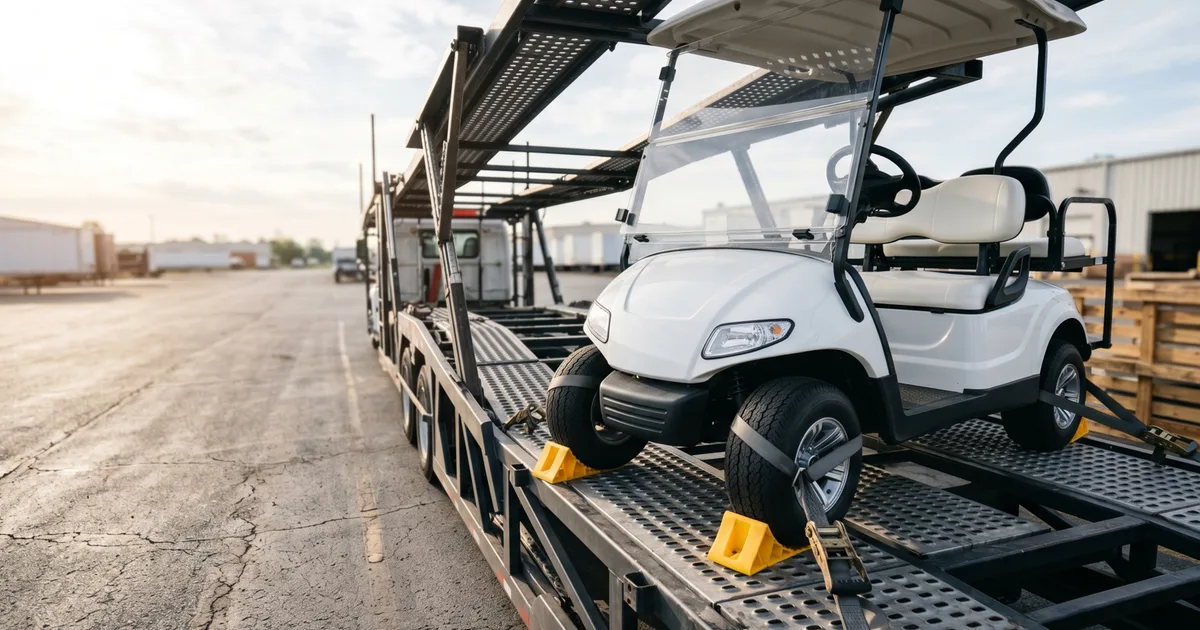
Open transport is the default for golf cart shipping. The cart rides on a flat or stepped trailer, exposed to the elements but secured with industrial-grade ratchet straps and wheel chocks. Open carriers are far more common than enclosed operators, which means quicker pickup windows and lower prices. For standard 2-passenger and 4-passenger carts on regional or cross-country routes, open transport is almost always the right call — a quick wash at delivery handles any road dust.
Enclosed Transport
Enclosed transport wraps the cart inside a covered trailer, protected from rain, road debris, and direct sun. Enclosed carriers also tend to carry higher cargo insurance limits — commonly $250,000 to $1,000,000, compared to the $100,000 baseline on open carriers — because they typically haul exotic cars, classics, and other high-value vehicles. Enclosed makes sense for high-end electric carts ($15,000+), custom-built or lifted carts where bodywork matters, vintage carts, and any cart traveling through severe weather. Expect to pay 30% to 50% more than open transport, and expect a longer pickup window because enclosed availability is thinner. The same open-versus-enclosed calculus applies to two-wheelers, and our rundown of the different types of motorcycles shows which styles typically ride open and which belong in a trailer.
Golf Cart Shipping Costs
Pricing for shipping golf carts follows the same per-mile model that moves cars, adjusted for the cart’s specifics. Shorter routes cost more per mile, longer routes less — a 100-mile move runs $1.40+ per mile while coast-to-coast drops below $1.00 per mile. Our cost to ship a car breakdown follows the same pricing logic if you want the full picture.
| Distance | Open Transport | Enclosed Transport |
|---|---|---|
| Local (under 100 miles) | $150–$300 | $250–$450 |
| Regional (100–500 miles) | $300–$700 | $450–$900 |
| Cross-country (500+ miles) | $700–$1,200 | $900–$1,500 |
Per-mile rates trend roughly $1.40 for the first 500 miles, $1.00 for 500 to 1,000 miles, and as low as $0.60 per mile coast-to-coast on high-density routes. These are reliable mid-2026 industry ranges across licensed brokers and direct carriers — the actual quote depends on the factors below.
What Affects Golf Cart Shipping Cost?
The same cart on the same route can quote at very different prices depending on these variables.
- Distance and route density. A 200-mile move on a busy I-95 corridor costs less per mile than a 200-mile rural detour. Carriers price routes based on how easily they can fill the rest of the trailer, so popular interstate paths are cheaper.
- Transport type. Enclosed transport adds 30% to 50% over open transport. For most standard carts, that premium isn’t necessary — the cart arrives in the same condition either way on a typical route.
- Cart size and configuration. A standard 2-passenger cart is the baseline. A 4-passenger cart adds modestly to the rate, a 6-passenger or limousine-style cart more significantly, and a lifted cart with off-road tires can add $50 to $150 because of trailer-clearance requirements.
- Snowbird seasonality. Demand for Florida-bound carts spikes between October and December as snowbirds migrate south; the return wave hits Northeast and Midwest destinations in April and May. Expect $150 to $350 more during peak snowbird windows compared to off-season rates. Our snowbird car transport overview explains the same seasonal dynamic for full-size vehicles, and the same logic applies to carts.
- Pickup and delivery accessibility. Tight communities, gated golf courses, and unpaved private drives may require terminal pickup or an extra fee. Sharing accurate access details up front avoids change orders at pickup.
- Battery type. Lithium-powered carts can require carrier-specific handling because of DOT hazmat thresholds. SAKAEM confirms compatibility with the assigned carrier in advance — some carriers transport with the battery installed, others require it disconnected or removed. Either way, the carrier-matching happens before pickup, not at the curb.
- Timing flexibility. Standard pickup windows of 1 to 5 days price lower than expedited service. Guaranteed pickup dates carry a premium of $100 to $300.
Pro tip — lithium battery hazmat: As of 2026, the U.S. Department of Transportation classifies large lithium-ion batteries above certain watt-hour thresholds as hazardous materials in transport. Some auto transport carriers don’t carry the required hazmat authority and will refuse a lithium-powered cart at pickup. Confirming the carrier’s hazmat status — or arranging for the battery to be disconnected before transit — should happen at the quote stage, not at the curb.
Top Golf Cart Shipping Corridors
Some routes carry far more golf cart freight than others, and route density directly affects price and pickup speed. The highest-volume corridors in 2026 typically include:
- The Villages, FL ↔ Michigan, Ohio, and the Northeast. Florida’s largest active-adult community generates a steady snowbird flow in both directions twice a year.
- Scottsdale and Phoenix, AZ ↔ Chicago, Minneapolis, and the Upper Midwest. Sun Belt retirees and second-home owners drive consistent demand on this corridor.
- Hilton Head and the Carolinas ↔ New England. Coastal vacation-home traffic concentrated in spring and fall.
- Palm Springs and the Coachella Valley ↔ the Pacific Northwest. Desert-to-coast routes with strong leisure-vehicle volume.
- Naples and Fort Myers, FL ↔ Texas and the Midwest. Secondary snowbird corridor with dedicated multi-cart loads from October through December.
Carts moving on these dense corridors usually quote 10%–20% lower than equivalent off-corridor routes because carriers can fill loads efficiently. If your move is along one of these paths, expect faster pickup windows too.
How Long Does Golf Cart Shipping Take?
Golf cart shipping takes about as long as full-size auto transport because most carts ride alongside cars on the same trailers. Local moves under 100 miles often complete the same day or next day. Regional moves of 100 to 500 miles typically take 2 to 5 days. Cross-country moves of 1,000 miles or more usually take 5 to 10 days, with coast-to-coast arrivals landing toward the longer end of that window. Pickup itself usually happens within a 1- to 5-day window after dispatch — that flexibility is what keeps rates reasonable, since carriers can route the cart efficiently rather than committing to a single day. If you need a guaranteed pickup or delivery date, expedited service is available for an added fee.
Should I DIY Ship My Golf Cart?
Knowing how to transport a golf cart yourself makes sense in narrow circumstances. If you already own a truck rated to tow at least 2,000 pounds, a 5x10 utility trailer or larger, ramps, four ratchet straps, and wheel chocks — and the move is under 200 miles — DIY can be the cheaper option. Pulling a cart behind an RV between a primary and vacation home is the most common legitimate DIY scenario, since the equipment is already on hand and the route is built into the trip.
Beyond 200 miles, the math turns against DIY fast. A 500-mile round trip burns $200 to $300 in fuel alone, before lodging, food, time off work, or trailer rental at $50 to $100 per day. Professional open transport often comes in cheaper once everything is totaled, and the cart is fully insured by the carrier’s cargo policy throughout — neither weather damage on an open trailer nor an improperly secured tie-down would typically be covered by a personal auto policy.
How to Choose a Golf Cart Shipping Company
The golf cart shipping market is fragmented, and the trust signals that protect you on a $30,000 sedan move are the same signals that protect you on a $15,000 cart move. Look for an FMCSA-licensed broker or carrier with active USDOT and Motor Carrier (MC) numbers, a current Certificate of Insurance, transparent pricing without lowball estimates that creep up later, and verified customer reviews on independent platforms like Google and the BBB. Avoid any company that asks for full payment up front, refuses to share its insurance certificate, or quotes a price that’s noticeably below the rest of the market — those are the patterns that show up in auto transport scams every year.
SAKAEM Logistics runs every carrier through a three-check verification before they’re assigned to a load. First, USDOT and MC numbers are confirmed against the FMCSA’s public database and cross-checked against the company’s stated operating authority. Second, the current Certificate of Insurance is pulled, policy effective dates and coverage limits are validated, and SAKAEM is added as a certificate holder so we receive direct notification from the insurer if anything changes. Third, the carrier’s FMCSA safety record is reviewed — active violations, out-of-service orders, hours-of-service compliance, drug and alcohol program status, and prior crash history. Carriers that don’t pass all three checks don’t move loads in our network.
For golf cart loads specifically, SAKAEM also verifies that the assigned carrier has experience with low-clearance and small-vehicle hauling, the right hazmat authority for the cart’s lithium-battery chemistry, and trailer dimensions that accommodate any lift kit, roof rack, or oversized passenger configuration. Most refused pickups, surprise damage, and curbside surcharges happen when a generalist carrier is dispatched without confirming these specifics. The carrier-matching layer is what prevents that.
Common Golf Cart Shipping Mistakes
When shipping golf carts, most refused pickups, surprise surcharges, and denied claims trace back to a small set of avoidable mistakes at the quote or pickup stage.
- Not disclosing that the cart is lifted or oversized. Lift kits raise the cart’s clearance above what some upper-deck trailer slots can accommodate. Disclose the lift height and overall dimensions when you request the quote.
- Not disclosing the battery type. Lithium-powered carts may require carrier-specific hazmat handling. Telling the broker the battery chemistry up front prevents the load from being refused at the curb.
- Assuming a gated community has carrier access. Many gated retirement communities, RV resorts, and golf courses don’t allow full-size auto transport trailers. Confirm gate dimensions and trailer access before pickup, or arrange a meet point at a nearby parking lot.
- Leaving accessories or personal items inside. Cargo insurance covers the cart, not its contents. Coolers, golf clubs, range finders, and other loose items are uninsured during transit and can shift and damage the cart’s interior.
- Skipping BOL photos at pickup. The Bill of Lading is the legal record of the cart’s condition. Without timestamped photos at pickup, a damage claim at delivery is much harder to win.
- Choosing the cheapest quote without verifying carrier capability. A lowball quote often reflects a carrier without the right trailer clearance, hazmat authority, or community access. The lowest number isn’t always the best move.
Bottom Line
Knowing how to ship a golf cart in 2026 comes down to a few decisions — distance, transport type, cart specs, and battery handling — and the right open or enclosed move runs $150 to $1,500, takes between same-day and 10 days, and arrives fully covered by the carrier’s cargo policy. The variables that move the price most are distance, transport type, snowbird seasonality, and battery handling for lithium-powered carts. Choosing a licensed, verified broker matters more than chasing the lowest quote — SAKAEM’s three-check carrier vetting and lithium-battery coordination keep the move clean from pickup to delivery. Request a quote and we’ll match your cart with the right carrier on the first call.
Golf Cart Shipping FAQ
Do I need to prepare my golf cart before shipping?
Yes, but the prep is short. Charge electric carts to full or fill gas carts to about a quarter tank, secure or remove loose accessories like phone mounts and cup holders, fold down windshields where possible, and clean the cart so the pickup inspection captures an accurate condition record. Photograph the cart from all four sides and the seat area before pickup — that’s your independent record alongside the BOL.
Is insurance included when shipping a golf cart?
Yes. Every FMCSA-licensed carrier is required to carry Motor Truck Cargo Insurance that covers your cart from the moment it’s loaded until it’s unloaded at delivery. Industry-standard coverage is $100,000 cargo with $750,000+ in liability. For high-value carts above $20,000, supplemental gap insurance is worth considering. Our full auto transport insurance breakdown explains how cargo, liability, and personal coverage layer together during transit.
Can I ship a lifted or oversized golf cart?
Yes. Lifted carts, 6-passenger limousine carts, and custom-built models all ship regularly, but they require more trailer clearance and sometimes a different carrier than a standard 2-passenger cart. Expect $50 to $150 added to the rate for a lifted cart and a slightly longer pickup window. Sharing exact dimensions, weight, and lift height when you request a quote prevents surprises at pickup.
Do I need to be present for pickup and delivery?
Someone authorized has to be present at both ends to inspect the cart with the driver and sign the Bill of Lading. That person doesn’t have to be you — it can be a spouse, neighbor, golf course staff member, or anyone of legal age who has your written authorization. The signature confirms the cart’s condition at each handoff and is the legal foundation for any cargo claim.
Are gas and electric golf carts shipped differently?
Gas and electric carts ride on the same carriers, but the prep differs. Gas carts ship with about a quarter tank of fuel — enough to load and unload without sloshing. Electric carts ship with the battery fully charged and disconnected at the negative terminal to prevent unintended discharge during transit. Lithium-powered electric carts may have additional handling rules under DOT hazmat regulations, which is why carrier-matching matters before pickup.
Do I need to remove the lithium battery before shipping?
Not always. Some carriers transport lithium-powered carts with the battery installed; others require it disconnected or removed before pickup. The decision depends on the cart’s lithium capacity, the carrier’s hazmat authority, and the route. SAKAEM confirms the carrier’s lithium handling policy before assigning the load — that conversation happens upstream so the cart isn’t refused at the curb.
Can you ship a golf cart to a gated community or golf course?
In most cases, yes. Gated communities, RV resorts, and golf courses are common pickup and delivery points for cart shipments. The driver needs gate access information, a contact person inside, and a clear path for the trailer to maneuver. If the trailer can’t reach the address — for example, a narrow private drive or low-clearance entrance — the driver may suggest a meet point at a nearby parking lot. Sharing access details when you request a quote saves time at pickup.
How is a 4-passenger cart priced compared to a 2-passenger?
A 4-passenger cart adds modestly to the base rate — typically $25 to $75 over a standard 2-passenger move on the same route. The pricing reflects the additional length and weight, which affects how the cart fits alongside other vehicles on the trailer. A 6-passenger or limousine-style cart adds more, often $75 to $200, because it usually requires a dedicated slot rather than fitting in beside a sedan.
Does cross-country shipping cost more in winter?
It depends on direction. Carts headed south to Florida, Arizona, and the Gulf Coast cost $150 to $350 more between October and December because of snowbird demand. Carts moving north or staying within the Sun Belt during the same window often see lower rates because southbound trailers run full and need return loads. The reverse pattern hits in April and May. Off-peak windows — January through March, June through September — typically offer the best mix of price and pickup availability.
What documentation do I need to ship a golf cart?
Less than you’d expect. The cart’s title and a government-issued ID for the person signing the BOL are sufficient for most domestic moves. Custom-built carts may benefit from a serial number or VIN-equivalent identifier on the BOL for insurance purposes. International shipments add export documentation, but those moves are handled separately from standard domestic transport.
Can I leave items inside the golf cart during shipping?
Generally no. Most carriers prohibit personal items inside the cart because cargo insurance covers the cart itself, not its contents — so anything left inside ships uninsured. Loose items can also shift during transit and damage the cart’s interior. Remove cooler bags, golf clubs, accessories, and anything not bolted to the frame before pickup.